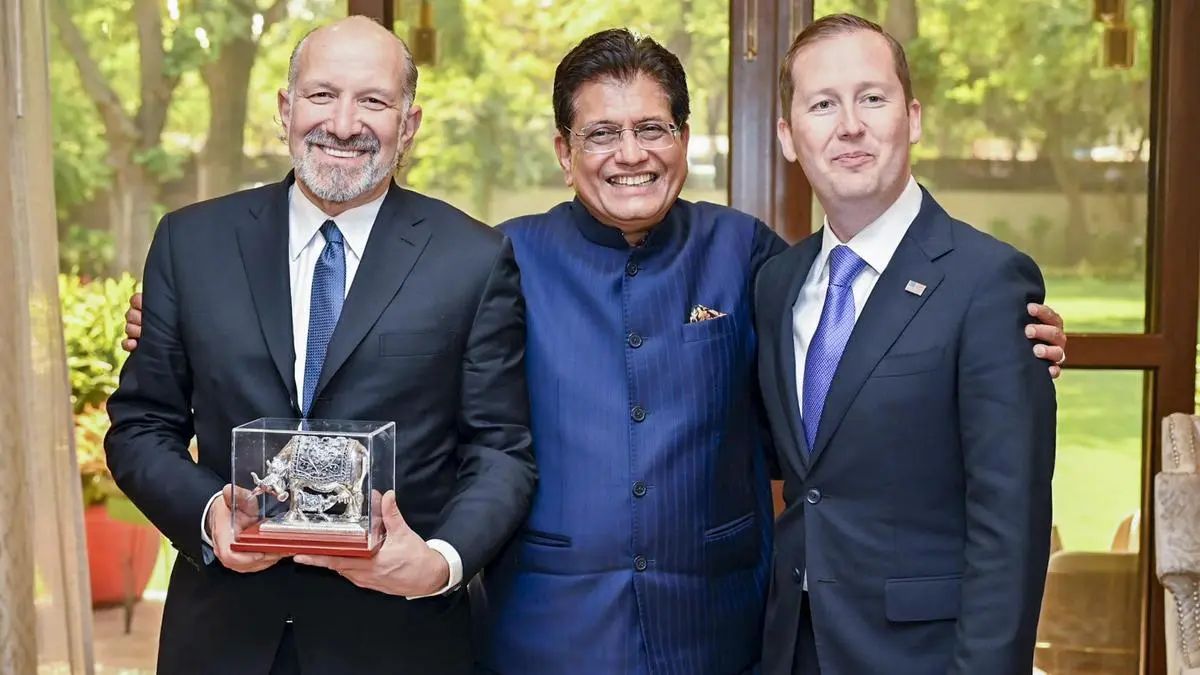
The air in New Delhi during a state visit doesn't just smell of exhaust and jasmine; it carries the electric hum of high-stakes theater. You can see it in the way the barricades go up, miles of orange steel cutting through the heart of the city, and in the way the silence settles over the Lutyens’ Bungalow Zone. To the casual observer, it is a logistical nightmare. To the diplomat, it is a heartbeat.
When the news cycle churns out headlines about an envoy’s reassurance or a president’s "deep care" for a bilateral bond, the words often hit the page with the thud of wet cardboard. They feel clinical. They feel like the product of a committee. But move past the press releases and look at the actual architecture of power.
The relationship between the United States and India isn't built on spreadsheets or shared maritime coordinates, though those exist in abundance. It is built on a specific, almost visceral recognition of identity. Eric Garcetti, the US Ambassador to India, recently underscored a sentiment that has been circulating through the corridors of the West Wing and the South Block: Donald Trump’s connection to India isn't just a matter of policy. It is a matter of conviction.
The Human Currency of Diplomacy
Consider a hypothetical shopkeeper in Queens, New York, named Arjun. He has lived in the States for thirty years. He pays his taxes, watches cricket on a grainy stream at 3:00 AM, and votes with his pocketbook. To him, the "strategic partnership" is an abstraction. But when he sees a US President standing in a stadium in Ahmedabad, hand-in-hand with the Indian Prime Minister, the abstraction vanishes.
That image—the "Howdy Modi" rally in Houston or the "Namaste Trump" event in India—wasn't just a photo op. It was a signal sent to the cellular level of two nations. For Trump, the appeal of India is often rooted in a shared appreciation for strength, scale, and the unapologetic pursuit of national interest.
The envoy’s recent comments weren't just filler for a slow news day. They were a reminder that beneath the transactional nature of trade tariffs and H-1B visas, there is a core of mutual respect that defies the standard "North vs. South" geopolitical tropes. Trump’s approach to India was characterized by a rare lack of lecturing. He didn't arrive with a checklist of moral corrections; he arrived looking for a partner in a very specific kind of fight.
The Invisible Stakes of the Indo-Pacific
We often hear the term "Indo-Pacific" tossed around in think-tank papers until it loses all meaning. To understand the stakes, stop thinking about maps. Start thinking about the phone in your pocket and the fuel in your car.
The waters between the Horn of Africa and the shores of California are the nervous system of the global economy. If that system suffers a stroke, the shopkeeper in Queens loses his inventory. The engineer in Bengaluru loses her contract. The envoy’s assertion that Trump cares deeply about this link is grounded in the reality that without India acting as a net security provider in the region, the American "pivot to Asia" is nothing more than a slow spin in place.
Under the previous Trump administration, we saw the elevation of the "Quad"—the informal grouping of the US, India, Japan, and Australia—from a sleepy talk shop to a formidable strategic pillar. This wasn't because of a love for multilateralism. It was because the reality of the 21st century demanded a counterweight to a rising, assertive China. India isn't just a market; it is the anchor.
The Friction of Real Friendship
It would be dishonest to pretend the path is paved with gold. True friendship, especially between two continental-sized democracies, is messy. It is loud. It involves shouting matches over poultry imports and digital tax laws.
There is a palpable tension when Washington looks at Delhi’s historical ties with Moscow. To an American strategist, India’s refusal to fully decouple from Russian energy or defense systems feels like a betrayal of the democratic "team." But to an Indian strategist, it is a matter of survival—a "strategic autonomy" born from decades of being told what to do by colonial powers.
Trump’s particular brand of diplomacy actually leaned into this friction. He understood the language of "America First" and respected the logic of "India First." There was a symmetry in the selfishness. By acknowledging that both sides were looking out for their own people, a strange kind of trust was formed. It was honest. It was transparent.
The Engine Under the Hood
Beyond the rallies and the rhetoric, the data tells a story of a quiet, relentless integration. In 2023, US-India bilateral trade hit record highs. We aren't just trading spices and software anymore. We are building jet engines together.
The iCET (Initiative on Critical and Emerging Technology) is a mouthful of an acronym, but its heart is simple: the US is sharing technology with India that it barely shares with its oldest NATO allies. Why? Because you don't give the keys to your most advanced tech to someone you don't trust to be there when the lights go out.
This level of cooperation is the "human element" in action. It represents thousands of American and Indian engineers sitting in the same rooms, solving the same problems, and realizing that their futures are inextricably linked. When the envoy speaks of Trump’s commitment, he is speaking to this momentum—a momentum that didn't stop when the administration changed and likely wouldn't falter if it changed back.
The Cultural Bridge
There is a specific kind of magic that happens when the diaspora becomes the diplomat. With over four million people of Indian origin living in the United States, the "bridge" isn't a metaphor; it’s a living, breathing demographic. They are the CEOs of the world’s largest tech companies, the doctors in rural clinics, and the voices in the halls of Congress.
This group acts as a permanent lobby for stability. They ensure that no matter who sits in the Oval Office, the "care" for the relationship is reinforced by the reality of the American workforce. Trump tapped into this energy. He recognized that the Indian-American community is one of the most successful, educated, and influential cohorts in the country. Their presence makes the India relationship domestic policy as much as foreign policy.
The Echo in the Halls of Power
History isn't made by documents. It’s made by people who decide to believe in a shared vision. The envoy’s words serve as a bridge between the past and a potential future, signaling that the "deep care" for India is not a partisan whim but a structural necessity.
Think of the relationship like a massive cargo ship. It takes a long time to turn, and it carries an immense amount of weight. While the waves of political rhetoric might splash against the hull, the engines underneath—the trade, the defense ties, the human connections—are humming at a frequency that is hard to disrupt.
The reality of the US-India bond is found in the quiet rooms of the Pentagon, the bustling offices of Hyderabad, and the suburban kitchen tables where families discuss their futures in both worlds. It is a story of two giants realizing they are better off standing back-to-back than face-to-face.
As the sun sets over the Potomac and rises over the Yamuna, the distance between the two seems to shrink. It is no longer about "the East" and "the West." It is about a shared realization that in a world of shifting sands, you need a partner who knows how to hold their ground. The bond isn't just strategic. It is, and always has been, personal.