The grass at the Estadi Olímpic Lluís Companys doesn't care about pop stars. It smells of damp earth and the heavy, metallic scent of anticipation that precedes an El Clásico. But on the chests of the men walking onto that pitch, the world is shifting. The vertical garnet and blue stripes of FC Barcelona—colors that have carried the weight of Catalan identity for over a century—have been hijacked by a butterfly.
Specifically, the "GUTS" butterfly.
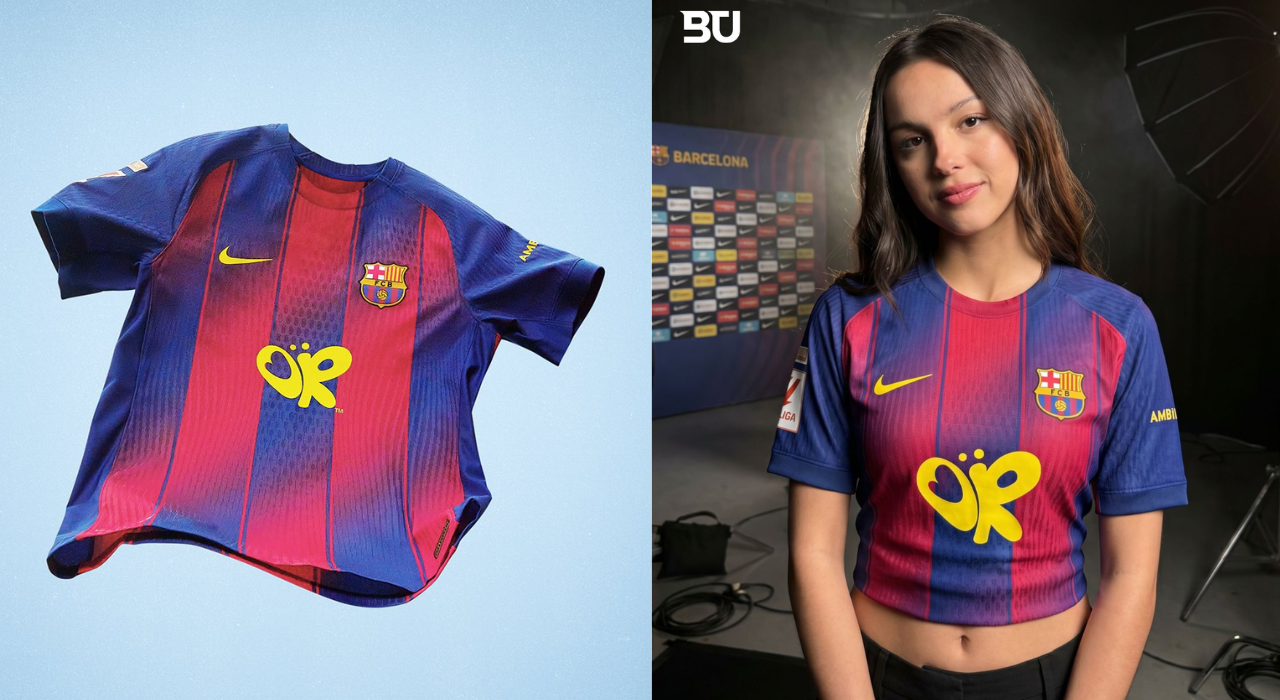
This is the newest chapter in a multi-million dollar marriage of convenience between Spotify and one of the most storied football clubs on earth. In a move that bridges the gap between Gen Z earbuds and the roar of a 50,000-seat stadium, Barcelona will wear the branding of Olivia Rodrigo for their high-stakes clash against Real Madrid.
The Economy of a Silhouette
To understand why a 124-year-old institution is trading its traditional sponsor slot for a 21-year-old singer’s iconography, you have to look past the pitch. You have to look at the "Superfine" jersey.
There are only 1,899 of these shirts in existence. That number isn't a coincidence; it’s the year of the club's founding. They are priced at approximately $435 USD (€399). For the casual observer, that is an exorbitant price for a piece of polyester. For the collector, it is a low-entry fee for a piece of cultural convergence.
Then there is the "Signed Exclusive."
Imagine a shirt touched by the sweat of the players and the ink of Rodrigo herself. Only 11 exist. One for each starter. The price tag for this relic? $3,270 USD (€2,999). It is a staggering figure that highlights a new reality in sports: the jersey is no longer just a uniform. It is a limited-edition asset. It is a wearable vinyl record.
The Ghost in the Machine
Consider a hypothetical fan named Mateo. Mateo grew up in the shadows of the Camp Nou. His grandfather told him stories of Johan Cruyff, of a time when the jersey was sacred and entirely unbranded. To Mateo, the "Més que un club" (More than a club) motto felt like a moral compass.
Now, Mateo watches as his club navigates a precarious financial tightrope. The Spotify deal, worth hundreds of millions, is the safety net. But the Olivia Rodrigo collaboration represents something more aggressive than survival. It is an attempt to capture the attention of someone like Mateo’s teenage daughter, Sofia.
Sofia doesn't care about the history of the 1992 European Cup. She cares about "Drivers License." She cares about the aesthetic of the "GUTS" world tour. By placing the Rodrigo butterfly where the Spotify logo usually sits, Barcelona is performing a digital heart transplant. They are trying to pulse their brand into the feeds of millions of young people who might not know the offside rule but know every lyric to "Vampire."
The Invisible Stakes of the Collab
This isn't the first time Spotify has played dress-up with the Blaugrana. We saw the OVO owl of Drake. We saw the "Motomami" logo of Rosalía. We saw the iconic tongue and lips of the Rolling Stones.
Each time, the internet fractures. Traditionalists decry the "commercialization" of the kit, while the club’s marketing department watches the engagement metrics skyrocket. The stakes are invisible but immense. If Barcelona fails to remain culturally relevant to the TikTok generation, they risk becoming a museum piece—a relic of a bygone era when local loyalty was enough to sustain a global giant.
The risk, however, is the dilution of the soul. When a club becomes a billboard for whoever is currently topping the charts, does it lose its own voice? Or is this simply the modern evolution of the "people’s club"—reflecting the actual culture the people consume?
The Anatomy of the Drop
The logistics of this "drop" mimic the hype-beast culture of Supreme or Yeezy. The collection includes not just the match-day kits, but a range of apparel: hoodies, t-shirts, and scarves featuring the fusion of the Barca crest and Rodrigo’s visual identity.
The strategy is clear: scarcity creates desire. By limiting the signed jerseys to a mere eleven pieces, Spotify and Barca have ensured a frenzy. These aren't just clothes; they are lottery tickets. They are status symbols that scream, I was there when the worlds of the stadium and the studio collided.
But for the player wearing the shirt, the pressure remains unchanged. Jude Bellingham or Vinícius Júnior won't run any slower because there’s a pop star’s logo on the opposing team's chest. The grass remains indifferent. The ball still moves at the same velocity.
The Final Score
In the end, the Olivia Rodrigo kit will likely sell out in minutes. The $3,500 price point for the signed editions will be met by collectors in Dubai, Los Angeles, and Tokyo. The club will receive a much-needed infusion of cash and a surge in global "cool" factor.
But as the sun sets over Barcelona and the stadium lights flicker on for the Clásico, the butterfly will have to withstand the heat of the world's most intense rivalry. For ninety minutes, the music stops. The brand deals fade into the background. There is only the white of Madrid, the blue and red of Barcelona, and the desperate, human need to win.
The jersey might belong to the highest bidder, but the game still belongs to the dirt, the noise, and the people who remember why the colors mattered before the logos arrived.