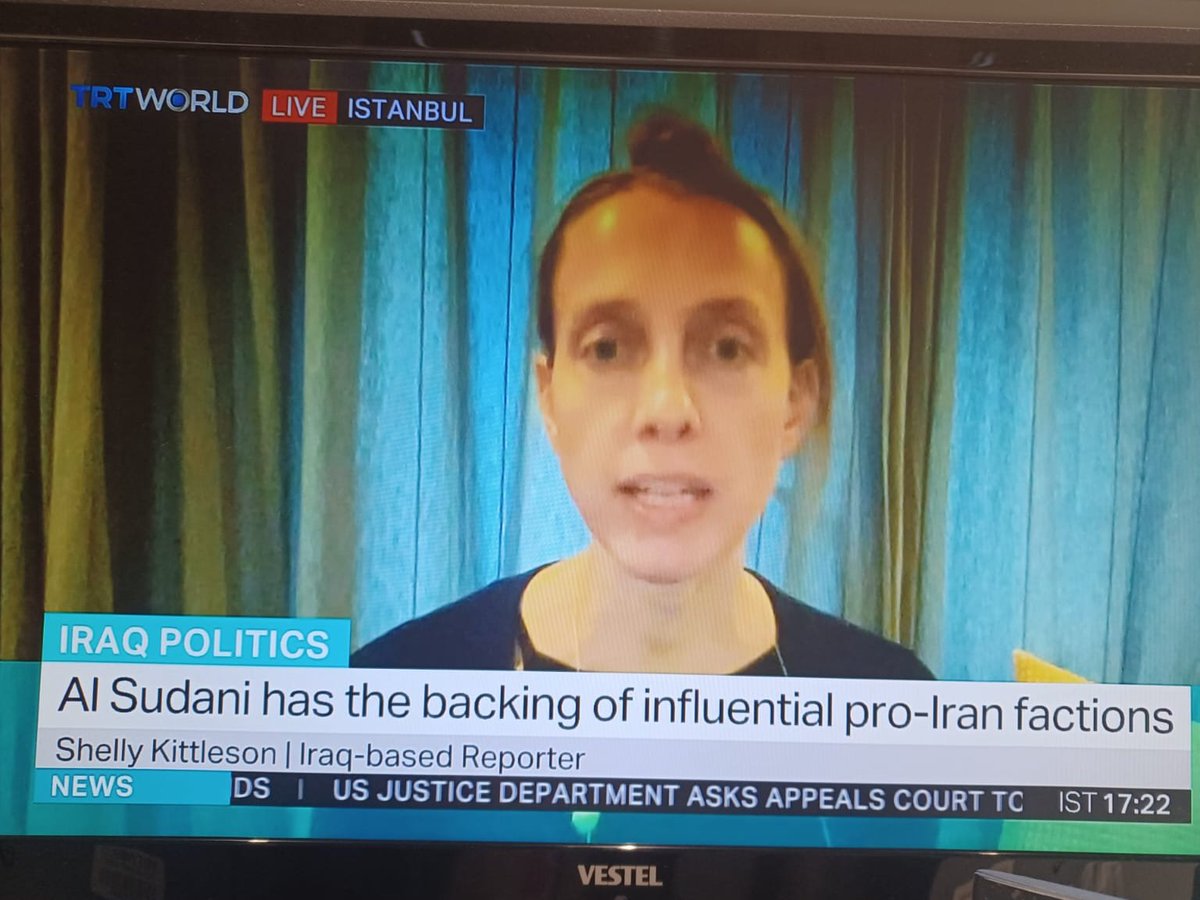
The reports began filtering through the usual channels late on a Tuesday, carrying the kind of chill that veteran correspondents in the Middle East know all too well. Shelly Kittleson, an American journalist with years of experience navigating the labyrinthine politics of Iraq, had vanished. She was reportedly taken from her apartment in the Karada district of Baghdad, a neighborhood that has historically served as a hub for media, intellectuals, and the very security apparatuses that failed to protect her. Her disappearance is not merely an isolated crime; it is a cold reminder that the "new" Iraq remains a place where the truth is often buried under the weight of militia influence and institutional paralysis.
Kittleson isn’t a novice. She is a reporter who understands the nuances of the Popular Mobilization Forces (PMF), the intricacies of the Yazidi struggle in Sinjar, and the delicate balance of power between the central government and the myriad armed factions that truly run the streets. Her kidnapping represents a calculated strike against the remaining vestiges of independent international reporting in a city that many in Washington and Baghdad want the world to believe is "stabilized."
The Karada Breach and the Myth of Security
Baghdad’s Karada district is a sprawling, vibrant area, but it is also one of the most heavily monitored zones in the capital. The idea that a foreign national could be spirited away from a residential building without the knowledge—or at least the passive consent—of local checkpoints is a fantasy. In Iraq, when a high-profile target disappears, it is rarely the work of a disorganized street gang. It is almost always a logistics-heavy operation requiring vehicles, intelligence, and the ability to pass through security cordons unchallenged.
The timing is particularly pointed. Iraq is currently attempting to rebrand itself as a regional mediator, a bridge between Tehran and Riyadh, and a safe harbor for foreign investment. A kidnapped American journalist shatters that narrative. It forces the Prime Minister’s office into a defensive crouch, caught between the need to satisfy international pressure and the reality that the perpetrators likely belong to the same armed groups that hold significant seats in the governing coalition.
The Ghost of 2004 in a 2026 Reality
We are no longer in the era of Zarqawi, where orange jumpsuits and grainy videos were the standard currency of abduction. The modern kidnapping in Iraq is often more clinical, sometimes referred to as "soft detention." The goal isn't always a ransom or a televised execution; often, it is a message of intimidation. By taking someone like Kittleson, the actors involved are signaling to the international community that there are "red zones" of inquiry that remain off-limits.
If you look at Kittleson’s recent body of work, you see a pattern of investigating the very entities that now likely hold her. She has spent years documenting the fallout of the war against ISIS and the subsequent power vacuum filled by the PMF. For a journalist, the "why" of a kidnapping is usually found in their last three months of notebook entries. When a reporter starts asking questions about the diversion of state funds to sanctioned militias or the extrajudicial detention of activists, they stop being a guest and start being a liability.
The Failure of the Institutional Shield
The U.S. State Department’s response typically follows a rigid script. Consular officials work behind the scenes, issuing "Privacy Act" waivers and maintaining a stoic silence to avoid "inflating the value of the hostage." But in the streets of Baghdad, silence is often interpreted as weakness. The Iraqi government, meanwhile, finds itself in a perpetual state of "investigation," a term that serves as a linguistic black hole where uncomfortable truths go to die.
There is a fundamental breakdown in the protection of the press that goes beyond physical safety. It is a legal and political abandonment. When the Iraqi judicial system refuses to prosecute known militia leaders for the assassination of local activists like Reham Yaqub or Hisham al-Hashimi, it creates a culture of impunity. In this environment, an American passport is no longer the talisman of safety it once was. It is just another piece of leverage in a much larger geopolitical poker game.
The Logistics of a Disappearance
To understand how this happens, one must look at the "Technical" vehicles—white SUVs with tinted windows and no license plates—that roam Baghdad with total freedom. These vehicles are the physical manifestation of the state's dual nature. One part of the government issues press badges, while another part, the "shadow state," uses these vehicles to snatch those who use those badges too effectively.
Witness accounts in these scenarios are notoriously difficult to gather. Shopkeepers turn off their CCTV cameras. Neighbors suddenly develop collective amnesia. They do this because they know the police won't protect them from the people who took the journalist. The police, in many cases, are the people who took the journalist, or at least they wear the same camouflage.
Mapping the Motives
Why Kittleson? Why now?
The geopolitical climate in Iraq is currently a tinderbox. With the ongoing debates regarding the presence of U.S. troops and the "Global Coalition" transition, the presence of an American journalist who can verify or debunk the government's claims of security is a problem.
- Intimidation of the International Press: Most foreign bureaus have retreated to the relative safety of Erbil or the Green Zone. Kittleson lived among the people. Taking her sends a message that no "safe" neighborhood exists for those who look too closely.
- Leverage in Budget Negotiations: Groups within the PMF are constantly jockeying for a larger slice of the national budget. A captive American can be a potent, if silent, bargaining chip in backroom dealings with the Prime Minister.
- Retaliation: It is possible this was a direct response to recent U.S. airstrikes or sanctions targeting specific militia leaders. In the asymmetric logic of Baghdad’s militias, a journalist is an easy, soft target to hit back at Washington.
The Sinjar Factor
One cannot discuss Kittleson’s work without mentioning Sinjar. The region remains a tangled mess of Turkish drone strikes, PKK-affiliated groups, and PMF units. Kittleson was one of the few who consistently trekked to these neglected corners of the country. Her reporting exposed the failure of the Baghdad-Erbil agreement to bring any semblance of peace to the Yazidi population.
In Sinjar, the lines between "terrorist," "liberator," and "state actor" are blurred to the point of invisibility. If Kittleson stumbled upon something regarding the illicit trade routes or the movement of specialized weaponry through the Syrian border, she would have crossed a line that the local power brokers guard with lethal intent. The border regions are the lungs of the shadow economy; they do not tolerate witnesses.
The Complicity of Silence
The international media cycle is fickle. A kidnapping makes headlines for forty-eight hours, then fades into a "developing story" at the bottom of the scroll, eventually becoming a footnote. This fatigue is exactly what the kidnappers count on. They know that if they hold a subject long enough without a video, the world moves on to the next crisis in Ukraine, Gaza, or domestic politics.
This silence is complicit. When major outlets pull their reporters out of Baghdad instead of demanding accountability, they cede the ground to those who use violence to dictate the narrative. The Iraqi government’s habit of blaming "unidentified gunmen" must be challenged. In a city where every street corner has a checkpoint, there is no such thing as an unidentified gunman—only those the state chooses not to identify.
The Strategy of the Shifting Narrative
As the days pass, we should expect the usual disinformation campaigns to begin. Pro-militia Telegram channels will likely start floating rumors. They might claim she was a spy, or that she was involved in "suspicious activities" that justify her detention. This is a standard playbook designed to muddy the waters and reduce public sympathy. It is the same tactic used against every dissident and journalist who has been disappeared in Iraq over the last decade.
The reality is simpler and far more grim. Shelly Kittleson is a professional who committed the crime of being effective. She worked in the "grey zones" where the state's official story and the street's reality collide.
The Necessary Response
Waiting for the Iraqi Ministry of Interior to provide answers is a strategy of failure. History shows that in these cases, only sustained, high-level diplomatic pressure and aggressive, public reporting on the perpetrators can force a release. The "backchannel" approach has its place, but it must be backed by the credible threat of consequences—be they economic sanctions on specific individuals or the withholding of security cooperation.
The kidnapping of Shelly Kittleson is a litmus test for the current Iraqi administration. If they cannot or will not secure the release of a high-profile American journalist taken from the heart of their capital, then their claims of sovereignty are hollow. They are not a government; they are a collection of departments operating at the whim of armed factions.
Every hour she remains in captivity, the cost of the truth in Iraq goes up. For the journalists still on the ground, the message is loud and clear: your credentials are paper, but the guns are real.
The focus must remain on the specific units operating in Karada during the window of her disappearance. We know the names of the brigades. We know who commands them. The "unidentified" must be given names, and the names must be held to account. The era of treating these disappearances as "unfortunate incidents" must end if there is to be any hope for a free press in the Middle East.
Iraq wants to be seen as a modern state. A modern state does not allow journalists to vanish into the night. It does not allow its streets to be patrolled by men who answer to no one. Until Shelly Kittleson is returned, any talk of Iraqi stability is nothing more than a well-funded PR campaign masking a deep, systemic rot. The international community needs to stop buying the lie.