The chandeliers at Mar-a-Lago do not just provide light. They hum. It is a low, expensive vibration that signals to everyone in the room that they have successfully navigated the friction of the outside world to arrive at the center of the universe. On this particular evening, the air smelled of lily of the valley and aged scotch. Tuxedos moved with practiced ease across the polished stone. Outside, the Florida humidity pressed against the glass like a discarded thought, but inside, the climate was a steady, curated seventy-two degrees.
Then, the world tilted.
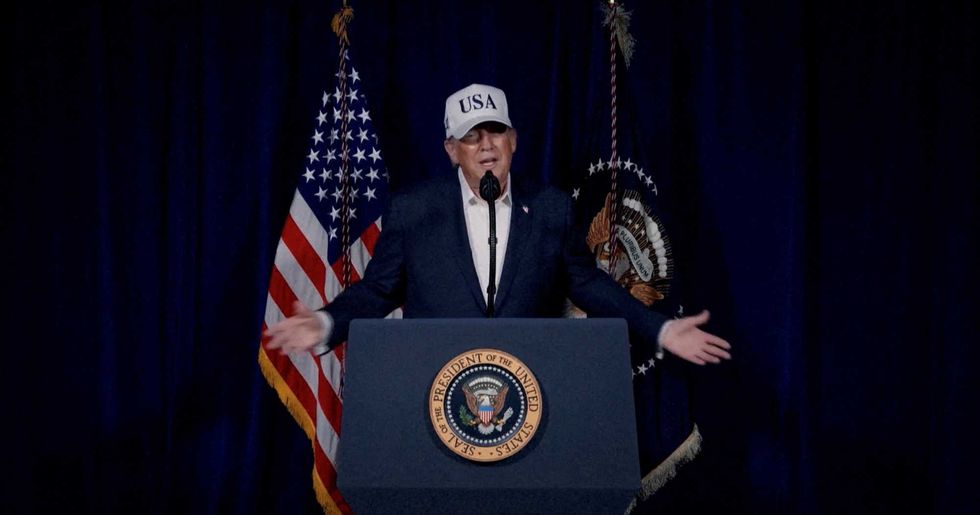
In a room designed for celebration, Donald Trump took the stage. He wasn't there to toast a wedding or commemorate a milestone. He was there to announce a war.
Consider the optics of a command center. Usually, we think of the Situation Room. We think of grainy monitors, the smell of burnt coffee, and the oppressive weight of windowless walls where the only thing that matters is the data streaming in from a distant time zone. There is a reason for that austerity. It strips away the ego. It focuses the mind on the human cost of every decision made in the dark.
But that night, the command center was a gilded ballroom. The advisors weren't generals in fatigues; they were donors in silk.
The Geography of a Crisis
When a leader initiates a conflict, they aren't just moving pieces on a map. They are signaling to the world—allies and enemies alike—where their priorities lie. When that signal is sent from a private club, the message becomes distorted. It suggests that the gravity of international fallout is secondary to the spectacle of the moment.
Imagine a family in a small apartment halfway across the globe. Let’s call them the Al-Saids. They aren't thinking about Palm Beach. They are thinking about the price of flour, which has just spiked because a trade route is now under threat. They are thinking about the power grid. To them, "foreign policy" isn't a talking point. It is a physical weight that determines whether their children eat or sit in the dark.
The distance between that apartment and the Mar-a-Lago fundraiser is more than just thousands of miles of ocean. It is a fundamental gap in reality.
When the news broke that the military action had been launched while the appetizers were still being circulated, the reaction wasn't just political. It was visceral. There is a specific kind of vertigo that comes from seeing a crisis managed through the lens of a social calendar. It creates a sense of "crisis inflation," where the stakes feel lower because the surroundings are so high-end.
The Cost of Distraction
Logistics matter. In the high-stakes environment of global conflict, every second of attention is a currency.
During a standard military operation, the President is surrounded by the National Security Council. There are secure lines. There are scrambled feeds. Most importantly, there is silence. This silence allows for the "what if" scenarios to be played out. What if the counter-strike hits a civilian target? What if the diplomatic backchannel fails?
At a glitzy fundraiser, there is no silence. There is the clinking of silverware. There is the "one more photo, Mr. President" request. There is the ambient noise of a hundred private conversations.
Critics argued that by launching a war from a party, Trump didn't just manage a crisis; he exacerbated it. They contended that the environment itself acted as a filter, softening the blow of the consequences. When you are surrounded by people who have paid thousands of dollars to be in your presence, the feedback loop is broken. No one in that room is going to tell you that the move is risky. No one is going to ask about the long-term geopolitical fallout while the band is tuning their instruments.
It was a performance of power that ignored the mechanics of power.
The Invisible Stakes
We often talk about the "theatre of war," but we rarely see it staged so literally. The danger of this approach isn't just in the immediate military outcome. It’s in the erosion of the office's perceived gravity.
Think about the last time you had to make a truly difficult decision. Maybe it was a medical choice for a loved one or a financial move that could ruin your future. Did you do it at a party? Probably not. You likely sought a quiet space. You wanted to feel the weight of it.
When a leader chooses to blur the lines between a private campaign event and a public military action, they are telling the public that the distinction no longer matters. They are saying that the "brand" of the presidency is more important than the "function" of the presidency.
This creates a ripple effect. Allies start to wonder if they can trust the communication coming out of such an environment. If a strike is launched between courses, is it a measured strategic move, or is it a play for the room? This uncertainty is where true danger lives. In international relations, clarity is the only thing preventing total escalation. When you trade clarity for "pizzazz," you invite the very chaos you claim to be fighting.
The Feedback Loop of the Elite
There is a psychological phenomenon where people in high-status environments feel a sense of invulnerability. It’s the "bubble" effect. When everyone around you is smiling and nodding, it becomes impossible to see the cliff’s edge.
The fundraiser at Mar-a-Lago wasn't just a gathering of wealthy individuals; it was a sanctuary. For the people inside, the "war" being launched was an abstract concept happening on a screen. It was something to be discussed over dessert. But for the sailors on the ships, the pilots in the cockpits, and the civilians on the ground, it was a sudden, terrifying shift in the fabric of their lives.
By staying in the ballroom, the leadership remained insulated from that terror.
This isn't just a critique of one man or one evening. It’s a warning about the future of how we handle global emergencies. If we allow the serious business of statecraft to become part of the entertainment industry, we lose the ability to distinguish between a headline and a catastrophe.
The crisis didn't just get worse because of the missiles. It got worse because the human empathy required to lead was replaced by the need to impress a donor base. It was a trade-off: a moment of applause in exchange for years of instability.
As the guests eventually filed out into the warm Florida night, their valets bringing around their cars, the world was a different place than it had been three hours prior. New tensions had been sparked. Old wounds had been reopened. And back in the ballroom, the staff began the long process of clearing the tables, picking up the stray napkins and half-empty glasses, while the hum of the chandeliers slowly faded into the silence of the coming dawn.
The lights went out, but the fire had already been lit.
Would you like me to look into the specific military protocols for launching strikes from non-secure locations?


