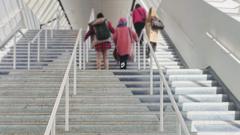
The granite underfoot is slick, a mottled grey that turns a deep, bruised charcoal when the North Sea mist rolls in. To a tourist, the Green looks like a postcard of Old Aberdeen. To an eighty-year-old woman clutching a plastic grocery bag, it looks like a mountain range.
There are exactly one hundred steps.
They connect the lower-level markets of the Green to the bustling heights of Union Street. In the local imagination, these stairs are more than just architecture; they are a gauntlet. If you stand at the bottom and look up, the perspective narrows into a sharp, intimidating wedge of stone. This is the "notorious" staircase, a vertical obstacle that has come to define the physical boundaries of who gets to belong in the heart of the city and who is relegated to the sidelines.
Now, city planners are looking at these stairs and seeing a problem that cannot be solved with another coat of paint or a sturdier handrail. They are looking at an escalator. Or, as one local councillor put it, a climb that feels like tackling half the Eiger north face.
The Invisible Wall
Imagine a man named Arthur. Arthur has lived in Aberdeen for sixty years. He knows the smell of the salt air before a storm and the specific chime of the Kirk bells. But Arthur’s knees are no longer the sturdy pillars they were when he worked the docks. For Arthur, the one hundred steps aren’t a shortcut. They are a wall.
When the physical environment demands a level of peak athletic performance just to reach a pharmacy or a bus stop, the city is sending a message. It says that the center of civic life is for the young, the able, and the unburdened. Every step is a tax on the elderly and the disabled. We often talk about urban planning in terms of "flow" or "density," but for someone with a stroller or a prosthetic limb, planning is about dignity.
The proposed "outdoor vertical transport solution"—a fancy term for a heavy-duty escalator—is more than a mechanical convenience. It is an admission that the way we built our past is currently choking our present.
The Engineering of Inclusion
The plan involves more than just plopping a mall escalator onto a sidewalk. Outdoor escalators are a different breed of machine altogether. They have to survive the Scottish winter, which is to say they have to survive a relentless assault of moisture, grit, and freezing cycles that can turn precision gears into scrap metal.
The technology required is a marvel of climate-proofing. We are talking about heated handrails to prevent ice buildup, internal drainage systems to channel away the horizontal rain, and sensors that can detect a single stray pebble before it jams the entire mechanism. It is a massive undertaking for a single stretch of street.
But why go to such lengths?
Consider the alternative: the status quo. Currently, the stairs act as a filter. They filter out the grandmother who wants to see the new art gallery. They filter out the father hauling a twin-engine pram. They filter out the student with a heavy gear bag who just wants to get to class without arriving drenched in sweat.
When you remove the barrier, you change the chemistry of the street. You don't just move people; you move energy.
A City of Two Levels
Aberdeen is a city built on top of itself. It is a three-dimensional puzzle of viaducts, tunnels, and raised platforms. This topography creates a strange social stratification. The upper levels feel modern, fast, and connected. The lower levels, like the Green, can often feel tucked away, forgotten, or cut off from the main artery of commerce.
By installing a mechanical link, the city is effectively stitching its two halves back together. The "Eiger" comparison isn't just hyperbole. In mountaineering, the North Face is the "ogre"—the impossible climb. By bringing an escalator to the Green, the city is attempting to slay its own local ogre.
There is, of course, the inevitable pushback. Critics argue that a modern metal snake will ruin the historic aesthetic of the granite city. They worry about the cost, the maintenance, and the potential for vandalism. These are valid fears. A broken escalator is just a very expensive, very ugly set of stairs.
Yet, there is a counter-argument rooted in the soul of what a city is supposed to be. A city is not a museum. It is a living, breathing organism that must adapt to its inhabitants. If the inhabitants are getting older—and they are—then the city must grow softer in the places where it is currently too hard.
The Weight of a Hundred Steps
Let's go back to those one hundred steps.
To a fit twenty-something, they represent about sixty seconds of light cardio. To someone with chronic pain, they represent a calculation. Is the trip to the market worth the pain I will feel tonight? That calculation is a tragedy. It is a quiet, daily erosion of freedom.
When we talk about the "cost" of the escalator project, we usually talk about millions of pounds. We rarely talk about the cost of not building it. We don't tally the loss of revenue from people who stayed home because the terrain was too hostile. We don't count the social isolation of the neighbor who stopped coming to the café because the climb became too steep.
The engineering is the easy part. We know how to move people vertically. We’ve been doing it in department stores and subway stations for over a century. The hard part is the shift in perspective. It’s moving from seeing a staircase as a "historic feature" to seeing it as a design flaw that excludes our own citizens.
The Cold Granite Reality
Standing at the top of the stairs today, you can see the potential. You see the vibrant life of the Green below—the independent shops, the street art, the history. You see the frantic energy of Union Street behind you. Between them is a gap of cold, grey stone.
The plan is ambitious. It is expensive. It is, perhaps, a bit radical for a city that prides itself on its stoic, "get on with it" attitude. But there is nothing stoic about watching a neighbor struggle to do something as simple as cross the street.
The granite will always be there. It is the bones of Aberdeen. But bones need joints to move. They need connections. If a mechanical belt of moving steps is what it takes to make the city whole again, then it is a small price to pay for a mountain conquered.
The mist starts to settle again, slicking the steps. A young woman starts the climb, her breath visible in the air. Halfway up, she pauses, looking at the steep incline still ahead. She is healthy, strong, and even she feels the burn.
Somewhere nearby, an older man looks at the same climb from his window and decides to stay inside.
He shouldn't have to.