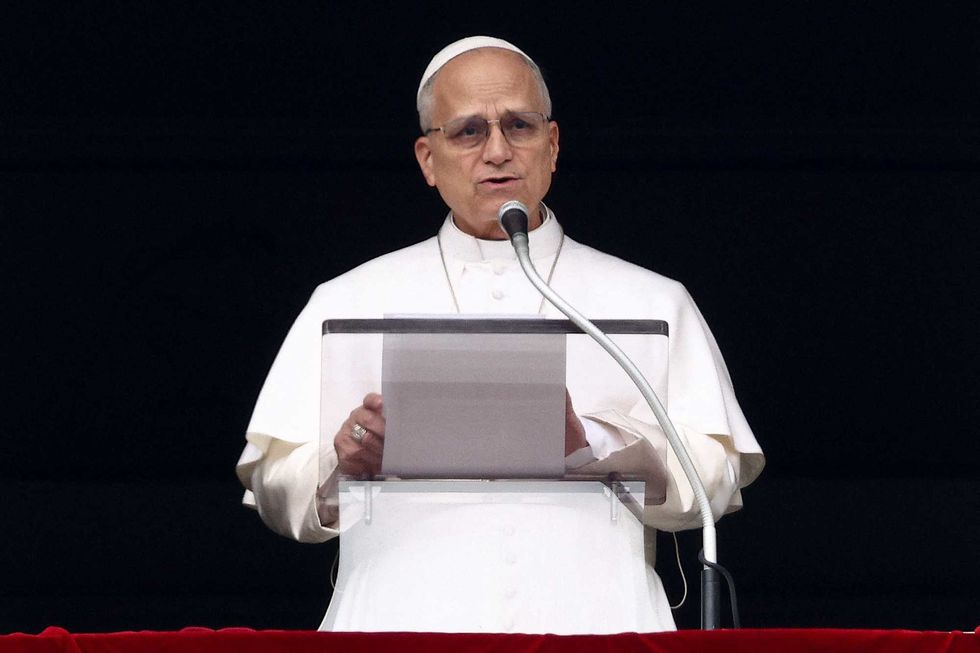
The air inside the Apostolic Palace does not circulate like the air in a modern office. It is thick with the scent of old floor wax, incense, and the literal weight of two millennia. When Pope Leo sits at his desk to address the specter of a fresh war in the Middle East, he isn't just a man in white looking at a map. He is a figure silhouetted against a long, bloody history of crusades, failed diplomacy, and the quiet, persistent sobbing of mothers who live in the dust of the Levant.
He looks tired. Not the tiredness of a long flight, but the exhaustion that comes from seeing the same cycle of violence reset itself every few decades. The news reports call it a "geopolitical shift" or a "strategic escalation." Leo calls it a moral failure.
The Ghost at the Table
Consider a hypothetical family in a village outside of Erbil or a suburb in the outskirts of a city we only hear about when it’s burning. Let’s call the father Elias. Elias doesn't care about the intricacies of Western foreign policy or the specific phrasing of a Vatican communique. He cares that the windows in his kitchen rattle every time a jet breaks the sound barrier. He cares that his daughter hasn’t slept through the night in three weeks.
When the Pope speaks of "moral responsibility," he is talking to the men in tailored suits thousands of miles away, but he is looking directly at Elias.
The standard news cycle treats war like a chess match. We discuss "assets," "surgical strikes," and "deterrence." These words are designed to be cold. They are linguistic armor that protects us from the reality of what happens when a piece of hot metal meets human skin. Leo’s intervention is an attempt to strip that armor away. He is essentially asking the leaders of the Free World a single, devastating question: If you knew the name of every person who would die because of your "strategic" choice, would you still make it?
The Burden of the Moral Giant
It is easy to dismissed the Vatican as a relic of a bygone era, a kingdom of symbols with no actual divisions to deploy. But that is a misunderstanding of power. True power isn't just the ability to destroy; it is the authority to define what is right. When the Pope expresses "deep concern," it isn't a suggestion. It is a formal marking of the conscience.
The United States often views itself as the global arbiter of justice. It’s a heavy mantle to wear. However, Leo’s message suggests that the mantle has slipped. By urging the U.S. to "assume the moral responsibility," he is pointing out a paradox: You cannot be the leader of the world if you are only interested in the parts of the world that serve your immediate interests.
Think of it as a bridge. On one side, you have the political reality of oil, alliances, and regional hegemony. On the other, you have the sanctity of human life. The Pope is the only person currently standing in the middle of that bridge, refusing to let anyone cross without acknowledging the cost.
The Silence of the Peacemakers
We have become addicted to the noise of conflict. We refresh our feeds for the latest explosion, the latest heated debate on a cable news panel, the latest "game-changing" weapon system. We have forgotten how to listen to the silence that follows.
In the hallways of the Vatican, silence is a tool. It is used for prayer, yes, but also for reflection. Leo’s public statements are rare enough that they should ring like a bell in a quiet room. Instead, they often get buried under the cacophony of political pundits.
But imagine the weight of that ring on his finger. The Fisherman’s Ring. It represents a commitment to the "little people"—the fishermen, the farmers, the laborers. When he looks at the Middle East, he doesn't see a theater of war. He sees a graveyard of potential. Every child in a refugee camp is a doctor who will never practice, a poet who will never write, a father who will never grow old.
The Logic of the Heart
Critics will say the Pope is being naive. They will argue that the world is a brutal place where only strength is respected. They will say that "moral responsibility" doesn't stop a drone or dismantle a terror cell.
They are right, in a narrow, cynical sense.
But history is a long game. The Roman Empire had the legions, but it was the quiet, persistent moral force of a small group of believers that eventually transformed the Western world. If we abandon the idea that there is a "right" and a "wrong" way to exercise power, then we have already lost the war, regardless of who wins the battles.
Leo’s concern isn't just about the Middle East; it’s about the soul of the West. He is worried that we are becoming comfortable with the "inevitability" of war. He is worried that we have outsourced our morality to algorithms and spreadsheets.
When he speaks, he is trying to wake us up from a long, technological sleep.
The Invisible Stakes
The real cost of war isn't just the billions of dollars spent or the thousands of lives lost. It is the erosion of trust. Every time a "moral" nation engages in a conflict that results in the deaths of innocents, the concept of morality itself becomes weaker. It becomes a joke, a cynical punchline used by dictators to justify their own atrocities.
Leo knows this. He knows that if the U.S. loses its moral compass in the deserts of the Middle East, it won't matter how many carriers it has in the Mediterranean. It will be a hollow giant.
Consider the ripple effect. A decision made in a wood-paneled room in Washington D.C. travels across the ocean, through the airwaves, and eventually lands in the heart of a young man in a displaced persons camp. If that decision is rooted in cold strategy, it breeds resentment. If it is rooted in a genuine attempt at peace, it might—just might—breed hope.
The Pope is betting on hope. It’s a risky bet. It’s a bet that has failed many times before. But as he stands by his window, looking out over a world that seems determined to tear itself apart, he continues to place it.
He doesn't have a choice. Neither do we.
The tragedy of power is that those who have it often forget what it’s for. They see it as a shield to protect themselves or a sword to strike their enemies. They forget that power is actually a debt. It is a debt owed to the people like Elias, who just want to be able to cook dinner without the windows rattling.
The letters Leo sends are more than just ink on parchment. They are a plea for us to remember that beneath the maps and the strategy, there is a pulse. There is a heartbeat. And every time a bomb falls, that heartbeat stops.
The Pope isn't asking for a miracle. He’s asking for us to be human. He’s asking for us to look at the Middle East not as a problem to be solved, but as a neighborhood to be healed.
It is a simple request, and yet, it is the hardest thing in the world to do. The sun sets over St. Peter’s Basilica, casting long, dark shadows across the cobblestones. The world continues to turn, and the drums of war continue to beat, but for a brief moment, a single voice has called out for a different path.
The question isn't whether the world will listen. The question is whether we can afford not to.
The ink on the Pope's latest statement is dry, but the blood in the streets is not.


