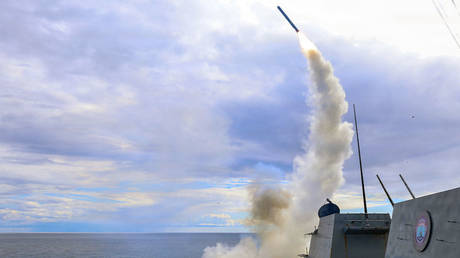
The air inside the cockpit of a Dassault Rafale feels different when the payload isn't a practice round. It is a sterile, recycled breath, filtered through a mask that presses against your face with the persistent weight of a physical interrogation. Beneath the wings, the ASMP-A missile sits in a state of quiet, terrifying potential. It is a sleek, white dart capable of carrying a nuclear warhead. It does not vibrate. It does not hum. Yet, for the pilot sitting inches above it, that single piece of hardware changes the gravity of the entire continent.
For decades, this specific brand of tension was a French monopoly. The "Force de Frappe"—France’s independent nuclear deterrent—was a solitary shield, forged by Charles de Gaulle to ensure that Paris would never again have to wait for a permission slip from Washington to defend its own soil. But the soil of Europe is shifting. The tectonic plates of geopolitics are grinding against one another with a screeching sound that can be heard from the Baltics to the Pyrenees.
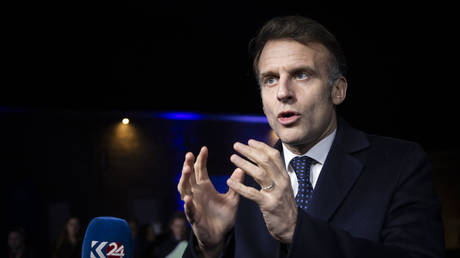
Emmanuel Macron has decided it is time to share the weight of the keys.
By offering to allow the temporary deployment of these nuclear-armed jets to European allies, the French President isn't just moving chess pieces. He is rewriting a social contract that has governed the continent since the end of the Second World War. To understand why this matters, you have to look past the dry press releases and into the eyes of a hypothetical Polish or Romanian commander watching a French squadron touch down on their tarmac. This is not a routine training exercise. It is the arrival of the ultimate insurance policy.
The Ghost of 1945
Europe has lived in a peculiar, comfortable bubble for a long time. We outsourced our survival. For eighty years, the unspoken assumption was that if the worst happened, the United States would arrive like a cinematic cavalry to sweep the board. It was a beautiful, expensive dream. But dreams have a habit of dissolving when the sun comes up on a cold morning.
The American political landscape is no longer a predictable monolith. With every election cycle, the "will they or won't they" drama regarding NATO commitments grows louder. France, ever the skeptic, has always maintained that Europe cannot be a sovereign power if it borrows its muscles from across the Atlantic.
Think of it as a neighborhood watch. For years, one neighbor—the one with the biggest house—owned the only security system. Everyone felt safe. Suddenly, that neighbor starts talking about moving away or changing the service plan. France is standing on its porch, holding a set of spare keys to its own alarm system, and asking the rest of the street if they want to learn how to use them.
The Anatomy of the Offer
The specifics of Macron’s proposal are surgically precise. We are talking about "temporary deployments." This isn't a permanent stationing of nuclear warheads in Berlin or Warsaw—that would be a diplomatic hand grenade tossed into the Kremlin’s front yard. Instead, it is a demonstration of agility.
It involves the Rafale jets and the tankers that feed them in mid-air. It involves the ground crews, the specialized technicians, and the high-security protocols that turn a standard airbase into a nuclear-capable bastion. When a French jet carrying a long-range cruise missile lands in a neighboring country, it sends a message that travels faster than any diplomat’s memo. It says: Our survival is intertwined. Your border is my border.
There is a technical term for this: "Strategic Ambiguity." It is the art of keeping an adversary guessing without ever saying too much. By moving these assets around, France makes it impossible for an aggressor to calculate the cost of an invasion. If the French deterrent is mobile, it is everywhere.
The Cost of the Shield
Let’s be honest about the discomfort this causes. Mentioning "nuclear" in a European cafe usually invites a shudder. We have spent decades trying to wish these weapons out of existence. There is a deep, psychic scar left by the Cold War—a memory of duck-and-cover drills and the constant, low-level hum of existential dread.
Macron is asking Europe to grow up.
Adulthood is the realization that safety is never a gift; it is a chore. By integrating European allies into the "culture" of French nuclear operations, Paris is forcing a conversation about what "European Sovereignty" actually means. It is easy to talk about a common defense when you are discussing uniform standards or shared satellite data. It is another thing entirely to stand on a runway and watch a jet loaded with the power to end a civilization taxi toward the takeoff strip.
The stakes are invisible until they aren't. We don't think about the structural integrity of a bridge until we see the cracks. The cracks in the post-war order are no longer hairline. They are wide enough to fall through.
The Paradox of Peace
There is a biting irony at the heart of this strategy. To ensure that these weapons are never used, we must act as if we are perfectly willing to use them. It is a psychological tightrope walk.
The pilots who fly these missions are among the most scrutinized human beings on the planet. They are not cowboys. They are scholars of the unthinkable. They spend their lives practicing for a day they pray will never arrive. When France deploys these crews to an ally’s soil, they aren't just bringing hardware. They are bringing a philosophy of restraint.
Critics argue that this move escalates tensions. They suggest that by spreading the footprint of nuclear-capable assets, we are poking a bear that is already cornered and angry. But there is a counter-argument that carries the weight of history: vacuum attracts pressure. If Europe leaves a hole in its defense, someone else will fill it.
France is attempting to plug that hole with a uniquely European solution. It is a move born of necessity, flavored with a bit of Gallic pride, and driven by a cold, hard look at the map.
A New Geography of Power
The map of Europe is being redrawn, not with ink, but with flight paths.
Imagine a map where the lines don't represent borders, but the reach of a Rafale’s radar. In this version of the continent, the center of gravity is shifting away from the old Cold War bastions and toward a more integrated, nervous, and proactive collective. This isn't just about France showing off its toys. It is about the slow, painful birth of a Europe that can stand on its own feet.
It is a terrifying process. It involves admitting that the world is more dangerous than we wanted it to be. It involves acknowledging that the "End of History" was just a long lunch break.
The next time a French jet touches down in a Baltic morning mist, the locals might look at it with a mixture of awe and anxiety. They should. That aircraft represents the most sobering responsibility a nation can hold. It is a reminder that peace is not the absence of weapons, but the presence of a deterrent so credible, so distributed, and so unified that the weapons themselves stay silent.
The keys are on the table. The invitation has been sent. Now, Europe has to decide if it is ready to pick them up and feel how heavy they really are.
The cockpit remains sterile. The pilot remains focused. The missile remains still. And in that stillness, the future of a continent is being weighed, one flight hour at least.