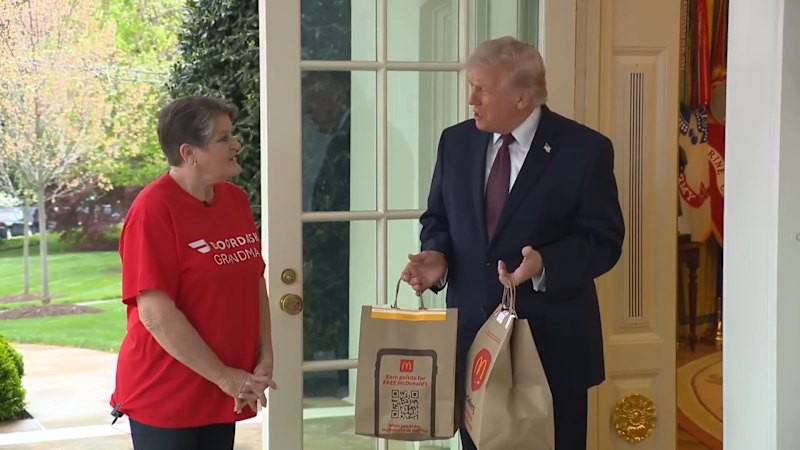
The media elite is obsessed with a Big Mac. Every time a photo surfaces of Donald Trump hosting a spread of silver platters piled high with lukewarm burgers, the commentary follows a predictable, lazy script. Critics mock the "cheapness" of the gesture. Supporters cheer for the "everyman" appeal. Both sides are completely missing the point. This isn't about a preference for processed meat or a lack of culinary refinement. This is a masterclass in logistical optics and power dynamics that most beltway insiders are too shielded to understand.
The Logistics of the Secret Service Kitchen
Most people imagine the White House kitchen as a five-star restaurant ready to pivot on a dime. The reality is a bureaucratic fortress. When you are feeding a championship football team or a massive delegation on short notice—especially during government shutdowns or staff transitions—the traditional kitchen becomes a liability, not an asset.
Ordering five hundred burgers isn't a failure of hospitality; it is an exercise in speed, safety, and standardized quality control. In the world of high-stakes security, a sealed bag from a massive franchise with standardized cooking protocols is often more "secure" than a complex, multi-ingredient meal prepared by a skeleton crew. I have seen executive teams at Fortune 500 companies freeze during a crisis because they tried to maintain the "prestige" of a catered lunch while the ship was sinking. Trump chooses the burger because the burger is a known quantity. It is the ultimate hedge against logistical failure.
The Performance of Relatability vs. The Reality of Power
The "lazy consensus" suggests that Trump eats fast food to prove he is one of the people. That is a surface-level read. The real play is the juxtaposition of the elite and the mundane.
When you place a three-dollar box of fries on a gold-rimmed plate under a portrait of Abraham Lincoln, you aren't trying to fit in. You are showing that you are so powerful you can redefine the environment. It is a psychological power move. By forcing guests—who are often elite athletes or high-ranking officials—to eat "peasant food" in the most prestigious room in the world, the host asserts total dominance over the social contract.
Why Your Critique is Historically Illiterate
Critics claim this "degrades" the office. This is a fundamental misunderstanding of American political theater.
- Bill Clinton used his jogs to McDonald's as a core part of his "Man from Hope" branding.
- LBJ held "barbecue diplomacy" on his ranch, serving greasy ribs to world leaders to keep them off-balance.
- Richard Nixon ate cottage cheese with ketchup.
The American presidency has always used food as a weapon to signal identity. Trump simply removed the pretense. He isn't pretending to enjoy a locally sourced arugula salad to appease the coastal donor class. He is betting that the average voter in Ohio or Pennsylvania cares more about a leader who eats what they eat than a leader who can pronounce "charcuterie."
The Economic Efficiency Argument
Let's talk numbers. A formal state dinner can cost tens of thousands of dollars per table. The security vetting for outside caterers, the procurement of specific ingredients, and the man-hours required for plating are staggering.
By comparison, a massive fast-food order is a rounding error in the federal budget. From a purely fiscal standpoint, it is the only time the federal government operates with the efficiency of a private-sector startup. While the press screams about the "death of dignity," they ignore the fact that the job of the President is to lead, not to act as a head waiter. Every minute spent debating the menu for a visiting sports team is a minute not spent on policy. The fast-food solution is a brutal, effective hack for the most expensive commodity in the Oval Office: Time.
The Nutritional Hypocrisy
The same pundits who decry the "health crisis" of a White House burger delivery are often the ones sipping $15 martinis at the Hay-Adams. There is a deep-seated classism in the outrage. We have medicalized the diet of the working class while romanticizing the caloric excesses of the elite.
Is a double cheeseburger healthy? No. But is it any less healthy than a five-course French meal dripping in butter and heavy cream? Mathematically, no. The difference is the packaging. We have been trained to view "processed" food as a moral failure and "artisanal" food as a virtue, even when the caloric and metabolic impact is identical. Trump’s food choices dismantle this hierarchy, which is exactly why it makes the establishment so uncomfortable. They hate that their gatekeeping of "good taste" has no power over him.
The Brand of Permanence
In a world of shifting trends and "fusion" cuisine, the Big Mac is a constant. It tastes the same in Tokyo as it does in Topeka. For a brand like Trump’s, which is built on the idea of a fixed, unmovable identity, this consistency is vital.
When you see that gold-and-red packaging in the State Dining Room, you are seeing a brand alignment. It signals that the occupant of the office has not been "changed" by the swamp. He hasn't started liking kale. He hasn't started caring about the "correct" wine pairing. He remains exactly who he was on the campaign trail. In marketing terms, this is impeccable brand integrity. Most politicians spend their entire careers trying to be chameleons; Trump wins by being a monument.
The Real Question You Should Be Asking
Instead of asking "Why is he serving burgers?" you should be asking "Why are we so easily distracted by the burgers?"
Every hour of cable news dedicated to a food delivery is an hour not spent discussing trade deficits, judicial appointments, or foreign policy. The food isn't the story; the reaction to the food is the story. The media falls for the bait every single time. They think they are exposing his "lack of class," while he is actually exposing their obsession with trivialities.
If you want to understand the modern political landscape, stop looking at the calories and start looking at the optics. The paper bag isn't a sign of a failing presidency. It’s a signal of a leader who knows exactly how to trigger his opponents into talking about lunch while he's busy rearranging the room.
The burger is the ultimate distraction. And you just finished the whole meal.