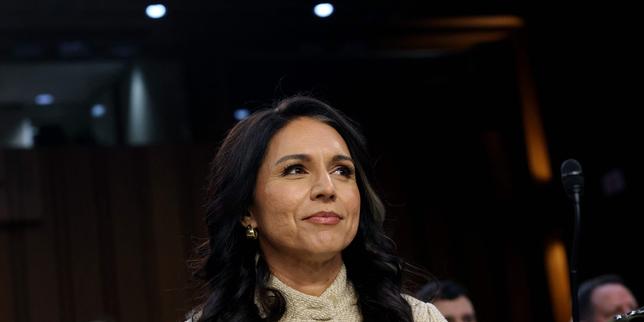
The air in the secure briefing rooms of Washington D.C. doesn’t circulate like normal air. It feels heavy, filtered through layers of lead and secrecy, carrying the faint metallic scent of high-end servers and the unspoken weight of life-and-death geography. Somewhere in the sprawling architecture of the Office of the Director of National Intelligence, a woman stands before a map of the Middle East. Tulsi Gabbard knows this map. She knows the terrain not just as a series of coordinates, but as a veteran who has smelled the dust of its roads.
History often hangs on a single word. In the corridors of power, that word is "nuclear." For a different view, see: this related article.
For years, the narrative surrounding Iran has been a pendulum swinging between "imminent threat" and "diplomatic stalemate." But recently, a fracture appeared in the highest levels of the American executive branch. It wasn't a crack in policy so much as a collision of reality and rhetoric. Donald Trump, a man whose political identity is forged in the fires of maximum pressure, has consistently framed Iran as a state on the brink of weaponization, a tiger lunging for the throat of the West.
Then came Tulsi Gabbard’s assessment. Similar analysis on this matter has been published by BBC News.
As the Director of National Intelligence, her job is to strip away the varnish of political desire and provide the raw, unadorned truth. Her recent findings did more than just provide data; they punctured a balloon of high-tension anxiety. She stated, with the quiet authority of a person holding the receipts, that Tehran had not, in fact, restarted its nuclear weapons program.
This isn't just a disagreement between a boss and an employee. This is a battle over the soul of American intelligence.
Consider a technician in a facility like Natanz or Fordow. Let’s call him Reza. In the standard political narrative, Reza is a shadow, a faceless cog in a machine designed to bring about Armageddon. We see him through the grainy lens of a satellite, a heat signature moving between centrifuges. In the "maximum pressure" worldview, every turn of Reza’s wrench is a countdown to a global catastrophe.
But Gabbard’s report suggests a different reality for Reza. It suggests that while the centrifuges might be spinning—enriching uranium for energy or medical isotopes—they haven't crossed the rubicon into weapons-grade material. The difference is 3.67 percent versus 90 percent. In the world of nuclear physics, that gap is a chasm. In the world of politics, it’s often ignored for the sake of a better headline.
Why does this distinction matter to the person sitting at home, thousands of miles away from the Persian Gulf? Because intelligence isn't just about what is happening; it's about what we are told is happening to justify what we do next.
If the intelligence is warped to fit a pre-existing desire for conflict, the consequences are measured in gravestones. Gabbard, having served in the medical corps in Iraq, understands this better than most. She has seen what happens when "certainty" about weapons of mass destruction meets the chaotic reality of a desert battlefield. To her, a false report isn't a clerical error. It’s a betrayal of the soldiers who will be sent to fix the mess.
The tension between Gabbard and Trump is a classic American drama. On one side, you have the President, who views intelligence as a tool for leverage. He wants the world to believe Iran is a monster under the bed because it makes his sanctions feel like a moral necessity. On the other side, you have an intelligence chief who views her role as a mirror. A mirror doesn't care if you don't like your reflection. It just shows you what is there.
The technical reality is mind-numbingly complex. It involves isotopes, heavy water reactors, and the delicate dance of the International Atomic Energy Agency (IAEA) inspectors. These inspectors are the world's most high-stakes hall monitors. They crawl through pipes and analyze dust samples, looking for the "signature" of a bomb.
Gabbard’s stance relies on their findings and the deep-cover intercepts that rarely make it to the evening news. She is effectively saying that the alarm bells we hear are being rung by hands in Washington, not hands in Tehran.
But don't mistake this for an olive branch.
Iran remains a volatile actor, a master of the proxy war and the cyber-skirmish. They aren't "the good guys." The nuance Gabbard is introducing is that they are rational actors. Rational actors can be bargained with. Rational actors respond to incentives. If you treat a rational actor like a cornered animal, eventually, they will become one.
The danger of the Trump narrative—that the program has already been relit—is that it leaves no room for the "quiet" work of preventing the fire. If the public believes the bomb is already built, the only logical conclusion is a strike.
Imagine the war room again. The lights are dimmed. The screens are glowing with the blue and green of tactical data. If the President looks at those screens and sees a threat that isn't there, he might order a "preventative" strike. That strike would, with absolute certainty, turn a dormant nuclear program into an active one. It would turn a cold war into a white-hot one.
Gabbard is standing in that room, effectively placing her hand on the President’s shoulder and saying, "Look closer."
Her dissent is a rare moment of institutional integrity. In a town where most people trade their principles for a better parking spot at the West Wing, she is choosing the uncomfortable truth. It is a lonely position. The hawks on one side call her an apologist; the hawks on the other call her a traitor to the administration's goals.
Yet, for the citizen, this friction is the only thing that keeps the machinery of war from running away with itself. We need the disagreement. We need the person who is willing to say "no" when everyone else is shouting "go."
The invisible stakes are the lives of people who don't even know these reports exist. They are the students in Tehran, the sailors in the Strait of Hormuz, and the families in suburban America who would feel the shockwaves of a global energy crisis or a new, endless conflict.
Gabbard’s assessment is a shield. It shields the country from a path built on a mirage. It acknowledges that Iran is a problem, but it refuses to invent a disaster where a dilemma will suffice.
The silent centrifuges in Iran aren't just pieces of machinery. They are the pivots upon which the next decade of global history will turn. If they stay silent, there is a chance for a different future—one where the maps in the briefing rooms don't need to be updated with new craters.
As the sun sets over the Potomac, the reports sit on the desks of the powerful. Some will be underlined in red; others will be tossed aside. But the truth has a way of outlasting the people who try to bury it. It waits in the data, in the dust of the inspectors' kits, and in the memory of a woman who knows exactly what it costs when a country chooses a convenient lie over a difficult peace.
The map on the wall hasn't changed, but the way we read it has. The woman between the war rooms has spoken, and for a brief, flickering moment, the world is forced to deal with things as they are, rather than as we fear them to be.