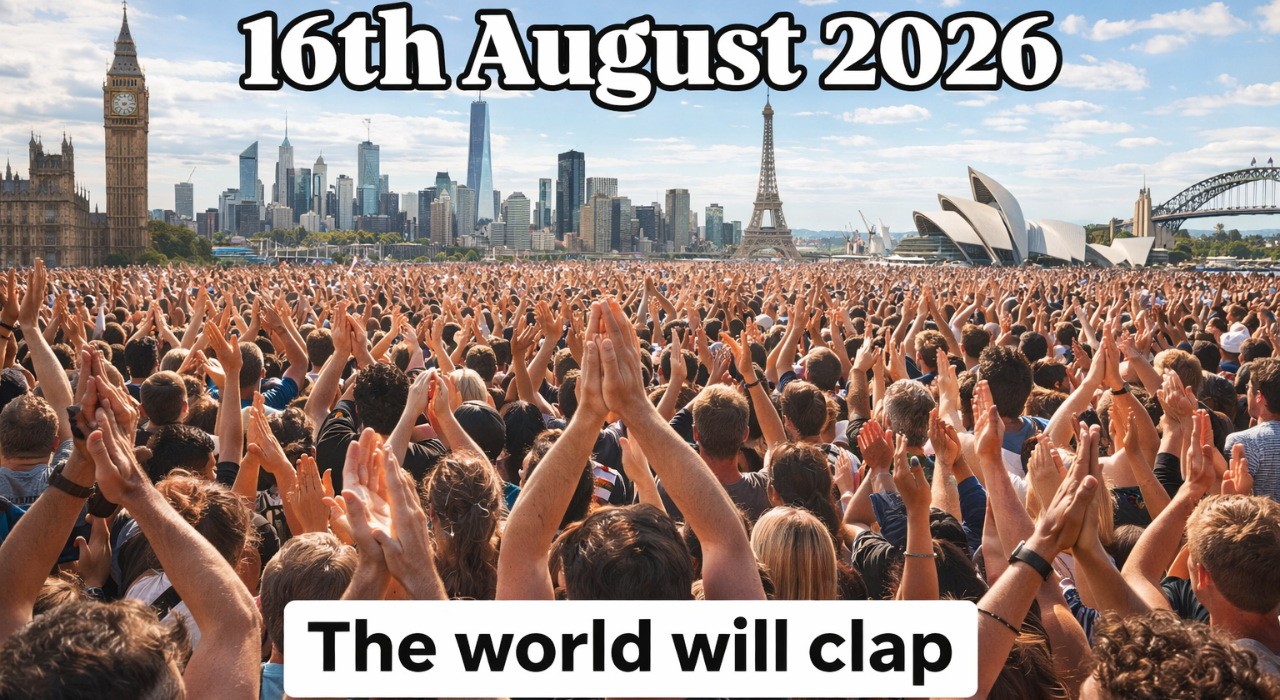
The vision of eight billion people slapping their palms together at once is a romantic fantasy for the mathematically illiterate. On August 16, 2026, the internet will try to convince you that "global harmony" is just one synchronized noise away. It is a feel-good trap designed by people who don't understand the speed of sound.
Stop thinking about the sentiment. Start thinking about the physics.
If the entire planet claps at once, the result isn't a "unified roar." It is a disjointed, chaotic mess of acoustic lag that highlights our distance rather than our connection. We are being sold a spiritual experience that is physically impossible to deliver.
The Latency Lie
The primary argument for World Clap Day rests on the idea of "togetherness." But "together" is a relative term governed by the laws of physics.
Sound travels at roughly 343 meters per second. If you are standing in a stadium and the person on the far side claps, you hear it nearly a third of a second later. Now, scale that to a city. Scale that to a continent.
Imagine a scenario where the "global clap" is broadcast via a live stream. Even with 2026-grade fiber optics, you are dealing with:
- Encoding latency: 10–100ms
- Network jitter: Variable
- Server processing: 20–50ms
- Human reaction time: 200–250ms
By the time you hear the "go" signal and your brain tells your hands to move, the person in the next time zone has already finished. There is no "at once." There is only a smeared, granular hiss of poorly timed impact. We aren't participating in a global symphony; we are participating in a multi-billion-dollar experiment in packet loss.
The Hollow Virtue of Low-Effort Activism
I have seen brands spend eight-figure budgets on "awareness events" that achieve exactly zero measurable change. World Clap Day is the ultimate manifestation of this "slacktivism." It asks for the absolute minimum level of physical exertion—hitting your hands together—and promises a sense of global belonging in return.
It is a cheap hit of dopamine that replaces actual community engagement.
If you want to help the world, clapping is the most useless gesture available. It feeds the ego of the organizer while providing the participant with a false sense of "having done something." Real change requires friction. It requires tension. It requires things that are significantly harder than a percussive gesture.
The Ecological and Social Cost of the "Vision"
The "one-man vision" behind August 16 ignores the massive infrastructure required to coordinate eight billion people.
To synchronize a global event of this scale, you need massive server uptime, satellite pings, and millions of kilowatt-hours of energy to keep the "live" feeds running. We are burning carbon to coordinate a noise that will be forgotten thirty seconds after it happens.
Furthermore, the "global" nature of this event is a western-centric delusion.
- August 16 at 12:00 PM GMT is 8:00 PM in Singapore.
- It’s 4:00 AM in Los Angeles.
- It’s the middle of the night for millions of people who actually have to work the next day.
This isn't a global moment. It’s a moment for people with high-speed internet and flexible schedules. The rest of the world is either sleeping or struggling, largely indifferent to the fact that a tech-bro in a climate-controlled office wants them to applaud.
Understanding the Acoustic Impossible
Let’s look at the math of the "Global Roar."
If we assume the average human clap produces a sound pressure level of roughly $80\text{ dB}$ at a distance of one meter, the collective noise of billions would, in theory, be immense. However, sound follows the inverse-square law:
$$L_p = L_{w} - 10 \log_{10}(4\pi r^2)$$
Where:
- $L_p$ is the sound pressure level.
- $L_w$ is the sound power level.
- $r$ is the distance from the source.
Because the human population is spread across $510$ million square kilometers, the "unified sound" is physically incapable of aggregating. You will only ever hear the person next to you. The "global" part of the experience exists only in the digital UI of whatever app is tracking the event. You aren't hearing the world; you are looking at a progress bar.
The Alternative: Stop Clapping, Start Acting
People often ask: "Why can't we just have one nice thing?"
The answer is that "nice things" like World Clap Day are distractions. They are the bread and circuses of the digital age. They provide a temporary mask for systemic isolation. We don't need a synchronized noise; we need unsynchronized, localized action.
If you feel the urge to participate in World Clap Day, do this instead:
- Delete the app. It’s likely harvesting your location data under the guise of "mapping the clap."
- Ignore the stream. The latency will only frustrate you if you have any sense of rhythm.
- Talk to your neighbor. Not through a screen. Not with a clap. With a conversation.
The organizers claim this event will "change how we see each other." I’ve spent two decades in media and tech, and I can tell you exactly what will happen: people will take a selfie of themselves clapping, post it with a hashtag, and then immediately return to their bubbles.
The event is designed for the photograph, not the feeling.
The Sound of One Hand Clapping (Virtually)
We are obsessed with the "entire planet" doing things. We want the "entire planet" to watch the same show, use the same currency, and now, make the same noise. This drive toward homogenization isn't unity—it’s a loss of texture.
The beauty of the human experience isn't found in a synchronized thump. It is found in the polyrhythms of different cultures, different times, and different lives. By trying to force everyone into a single moment of acoustic compliance, we are erasing the very diversity we claim to celebrate.
August 16, 2026, will come and go. A few million people will slap their hands together. The servers will spike. A few influencers will get their engagement metrics. And the next day, the world will be exactly as quiet, or as loud, as it was before.
The "vision" is a gimmick. The "unity" is a glitch.
Stop clapping and look at the person standing right in front of you. That’s the only scale that matters.