The ice in the tumbler doesn't rattle when the floor shakes. It vibrates. A low-frequency hum that travels through the soles of expensive loafers and into the marrow of the bone. In the penthouse suites of Dubai and the sleek villas of Riyadh, that vibration has become the soundtrack of a new, frantic reality.
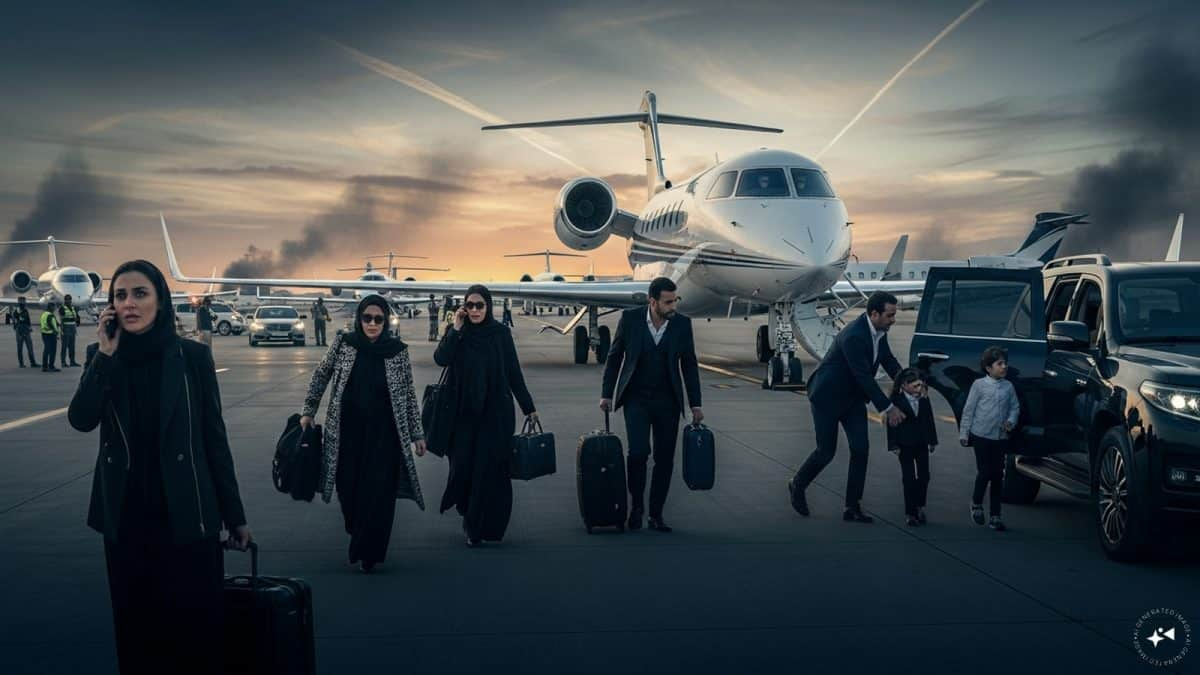
When the first reports of Iranian missiles streaking toward major urban centers hit the encrypted messaging groups of the world’s ultra-high-net-worth individuals, the reaction wasn't a slow migration. It was a stampede. But this is a stampede that happens in silence, behind tinted windows and inside the mahogany-clad cabins of Gulfstreams.
The Price of a Horizon
Fear is the ultimate market disruptor. In the span of forty-eight hours, the cost of a seat on a private charter fleeing the Gulf didn't just rise; it mutated. Brokers who usually handle routine business hops to London or Geneva found themselves fielding calls at 3:00 AM from frantic family offices. The request is always the same: Get us out. Now.
Standard private jet charters that might typically cost $40,000 have seen their price tags balloon to $350,000 for a single one-way leg. This isn't just a markup. It is a "war risk" premium, a cocktail of soaring insurance costs, pilot hazard pay, and the simple, brutal math of supply and demand. There are only so many long-range jets on the tarmac, and there are far more billionaires than there are flight paths.
Consider a hypothetical patriarch—let’s call him Elias. Elias has built a real estate empire that spans three continents. He sits in a room decorated with art that costs more than most small-town hospitals. Yet, as the news cycle flickers with images of interceptors lighting up the night sky over Isfahan and the subsequent retaliatory strikes, his net worth feels remarkably abstract. His only concrete reality is the ticking clock. He needs to move twelve family members, three staff, and a handful of essential documents to a secondary residence in Cyprus or Malta.
For Elias, $350,000 is an invoice he will pay without blinking. It is the cost of a certain kind of silence—the silence that comes when the cabin door seals and the jet climbs above the reach of regional instability.
Logistics of a High-Altitude Exodus
The mechanics of this flight are a nightmare of bureaucracy and physics. When a region becomes a "hot zone," the airspace doesn't just close; it becomes a jagged puzzle. Pilots have to navigate around shifting "no-fly" coordinates, staying clear of potential missile corridors while managing the stress of flying into areas where GPS jamming is becoming a daily occurrence.
Insurance companies are the invisible hand at the throat of this industry. The moment a kinetic conflict escalates, the "War Risk" clauses in aviation insurance policies trigger. Suddenly, the premium to land a $70 million Global 7500 in a city under threat isn't just high—it’s astronomical. Some insurers refuse coverage entirely, forcing operators to self-insure or pass that terrifying liability directly to the passenger.
This explains the jump to six-figure flight costs. You aren't just paying for the fuel or the flight crew’s time. You are paying for the risk of a hull loss. You are paying for the fact that the pilot is glancing at the radar with a different kind of intensity than they did a week ago.
- Insurance Spikes: Premiums can increase by 500% overnight when a city enters the crosshairs.
- Fuel Surcharges: Fueling up in a crisis zone involves complex logistics and limited supply, driving up the "per gallon" cost significantly.
- Permit Chaos: Landing slots in "safe" havens like Zurich or Larnaca disappear in minutes.
The Human Side of the Gold-Plated Life Raft
We often view the ultra-wealthy as untouchable, shielded by layers of security and offshore accounts. But the current escalation between Iran and its neighbors has stripped away that illusion. There is a specific kind of vulnerability that comes with having everything to lose.
In the private terminals—the FBOs (Fixed Base Operators)—the atmosphere has shifted from the usual bored luxury to something resembling a high-stakes hospital waiting room. People are traveling light. They are carrying jewelry rolls and hard drives instead of trunks of designer clothes. They are checking their watches. They are looking at their children.
The "invisible stakes" here aren't about the money. The money is just the tool. The real stake is the realization that no amount of gold can stop a ballistic trajectory. The wealthy are fleeing not because they have lost their assets, but because they have lost their sense of predictability. The Gulf has long been a glittering anomaly—a place of extreme prosperity in a volatile neighborhood. That bubble hasn't burst, but it has certainly thinned.
The Geography of Safety
Where do they go? The flight paths tell a story of global alignment. Cyprus has become a primary "lily pad"—a short jump out of the immediate danger zone where families can catch their breath before moving on to London, Paris, or New York.
Turkey remains a major corridor, though its own complex political standing makes it a calculated risk for some. The European "Golden Visa" countries are seeing a sudden surge in interest. It isn't just about a vacation anymore; it's about a permanent "Plan B" being activated in real-time.
The data shows a 400% increase in inquiries for immediate private charters out of the region following the most recent exchange of strikes. This isn't a speculative trend. It is a documented flight of capital and personhood.
But for every jet that leaves, there is a question left behind on the tarmac. What happens to the cities they leave? When the "0.1%" depart, they take more than just their bank balances. They take the confidence that sustains a global hub.
The Illusion of Distance
There is a hollow feeling in the gut when you realize that safety is a commodity. For those of us watching from a distance, the $350,000 price tag feels like a dispatch from another planet. But it reveals a fundamental truth about our current era: the distance between "normal life" and "emergency exit" is narrowing for everyone.
The wealthy are simply the canaries in the coal mine, equipped with faster wings.
As the sun sets over the Persian Gulf, the lights of the skyscrapers flicker on, mirrored by the heat signatures of engines climbing into the dark. Down on the ground, the markets react. Gold climbs. Oil fluctuates. But in the air, there is only the steady, expensive drone of a machine carrying a family toward a horizon that isn't glowing with the wrong kind of light.
The invoice will arrive on Monday. The relief arrived the moment the wheels left the ground. It is a steep price for a few hours of peace, yet in a world where the sky is no longer a ceiling but a source of dread, many are finding that $350,000 is a bargain.
The cockpit light glows a soft, reassuring green. Below, the borders of nations are invisible. Only the fires are easy to see.