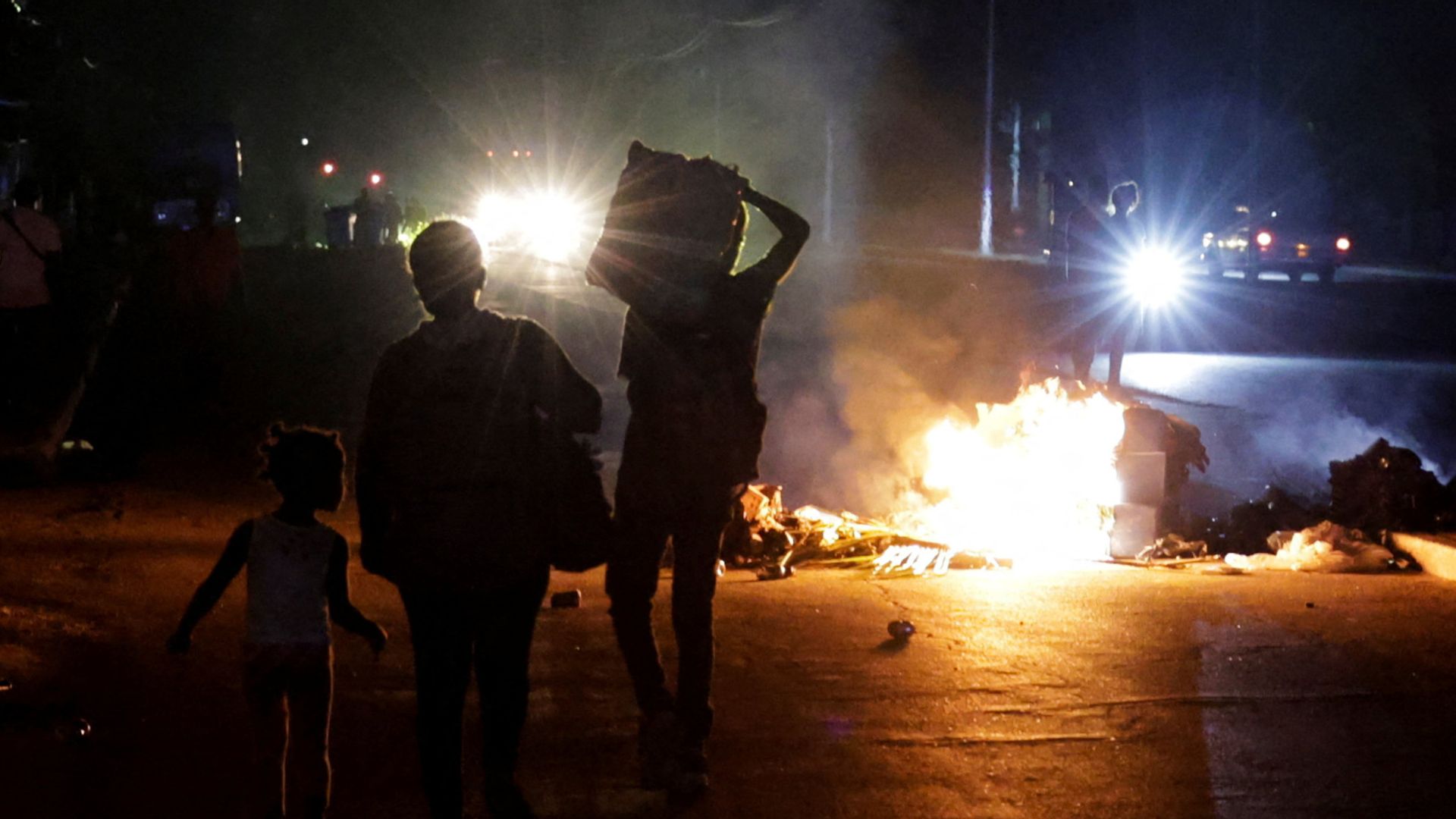
Donald Trump insists he can end the war in Iran "peacefully or otherwise" without lifting a finger toward Beijing. On the surface, the math supports him. Operation Epic Fury has effectively crippled Iranian infrastructure, and the subsequent maritime blockade under Project Freedom is costing the Islamic Revolutionary Guard Corps an estimated $170 million in lost revenue every single day. But the bravado of the briefing room ignores a fundamental reality of modern warfare. Weapons systems do not run on rhetoric, and blockades do not stop the flow of digital bits or dual-use components that keep a high-tech insurgency alive.
While the Pentagon prepares for a potential resumption of strikes—whispered in the halls of the E-Ring as Operation Sledgehammer—the true architecture of this conflict is being designed in the boardrooms of Dalian and the satellite labs of Chang Guang. Trump does not just need China to act as a diplomatic mediator. He needs China because they hold the keys to the Iranian supply chain that the U.S. Navy cannot reach. If you liked this article, you should look at: this related article.
The Mirage of Autonomy
The administration’s argument that Washington can resolve the crisis unilaterally is built on a dated understanding of "Maximum Pressure." In 2018, sanctions were a blunt instrument. In 2026, they are a sieve. Despite the U.S. naval presence in the Strait of Hormuz, Iranian oil continues to move eastward, often rebranded at sea or moved via a "shadow fleet" that exists entirely outside the dollar-clearing system.
China currently absorbs roughly 80% of Iran’s oil exports. This isn't just a trade relationship; it is a lifeline that renders the U.S. blockade a partial success at best. If Trump wants to force Tehran to a definitive settlement, he has to convince Xi Jinping to stop the "teapot" refineries from processing Iranian crude. Without Beijing’s compliance, the economic floor for the Iranian regime remains solid enough to withstand a long, grinding war of attrition. For another angle on this development, refer to the latest coverage from The Washington Post.
The Geospatial Intelligence Gap
The military dimension is even more entangled. Recent intelligence confirms that three Chinese firms—Meentropy Technology, The Earth Eye, and Chang Guang Satellite—have been providing Iran with high-resolution geospatial intelligence throughout the conflict. This data allows Iranian drone and missile teams to reposition assets in real-time, dodging U.S. surveillance and finding gaps in the Aegis defense umbrella.
No amount of U.S. kinetic force can "end" a war when the adversary has a bird’s-eye view provided by a third party. To blind the Iranian military, Trump must first strike a deal with the provider of that vision. This is the leverage trap. To win in the Gulf, Trump must give Xi something he wants in the Pacific or on the trade floor.
Mediation as a Weapon
China has spent the last year positioning itself as the "adult in the room." While the U.S. and Israel launched coordinated strikes in February 2026, Beijing dispatched envoy Zhai Jun on a regional tour that looked less like a peace mission and more like a rebranding exercise. By securing the fragile two-week ceasefire in April through Pakistani channels, China proved it has the ear of Tehran in a way Washington never will.
Beijing’s Five-Point Proposal for the Strait of Hormuz isn't just about peace; it’s about establishing a new regional security framework that excludes the United States. They are playing a long game. Every day the war continues, the Gulf states—longtime U.S. allies like Saudi Arabia and the UAE—begin to look toward China as a more stable partner that can actually restrain Iran.
The Dual-Use Pipeline
We are no longer dealing with a military that relies on Cold War hardware. The 2026 Iranian war machine is built on:
- Solid rocket fuel precursors (like sodium perchlorate) shipped from Chinese ports.
- MANPADS (Man-portable air-defense systems) moving through third-country proxies.
- Electronic warfare suites derived from Chinese dual-use radar technology.
If Trump ignores China, he is essentially trying to drain a bathtub while the faucet—controlled by Beijing—is running at full blast.
The Price of a Handshake
The upcoming summit in Beijing represents the most significant diplomatic hurdle of the Trump presidency. The "stable" prices at the pump—currently hovering around $4.50 per gallon—are an illusion of stability. If the ceasefire on "life support" fails and the Strait of Hormuz closes completely, the global economy faces a recession that neither Washington nor Beijing can afford.
Trump’s leverage is the U.S. dollar and the threat of secondary sanctions on major Chinese banks. Xi’s leverage is the physical survival of the Iranian state and the stability of global energy flows. The "win" Trump seeks won't be found on a battlefield in Khuzestan. It will be found in a trade-off where Iranian regional compliance is exchanged for U.S. concessions on semiconductor export bans or Taiwan-related maritime activity.
The Brutal Reality of 2026
The war in Iran has revealed the limits of American kinetic dominance. You can destroy a missile silo, but you cannot easily destroy a 25-year strategic cooperation agreement between two nuclear-armed or nuclear-adjacent powers. China has already surged its strategic reserves to 1.4 billion barrels, enough to weather four months of total import disruption. They are prepared for a long war; the American voter, paying record prices for fuel and watching the 60-day War Powers clock expire, is not.
Trump’s path to a "great deal" is not a straight line from Washington to Tehran. It is a triangle that must pass through Beijing. To ignore China is to ensure that the war in Iran remains an open wound, bleeding American resources and credibility until there is nothing left to salvage. The era of the unilateral solution is dead. The ending of this war will be written in Mandarin as much as it is in English.
Failure to acknowledge this doesn't just prolong the conflict. It guarantees that when the dust finally settles, the new regional order will be one where the U.S. is an occasional visitor and China is the permanent landlord.