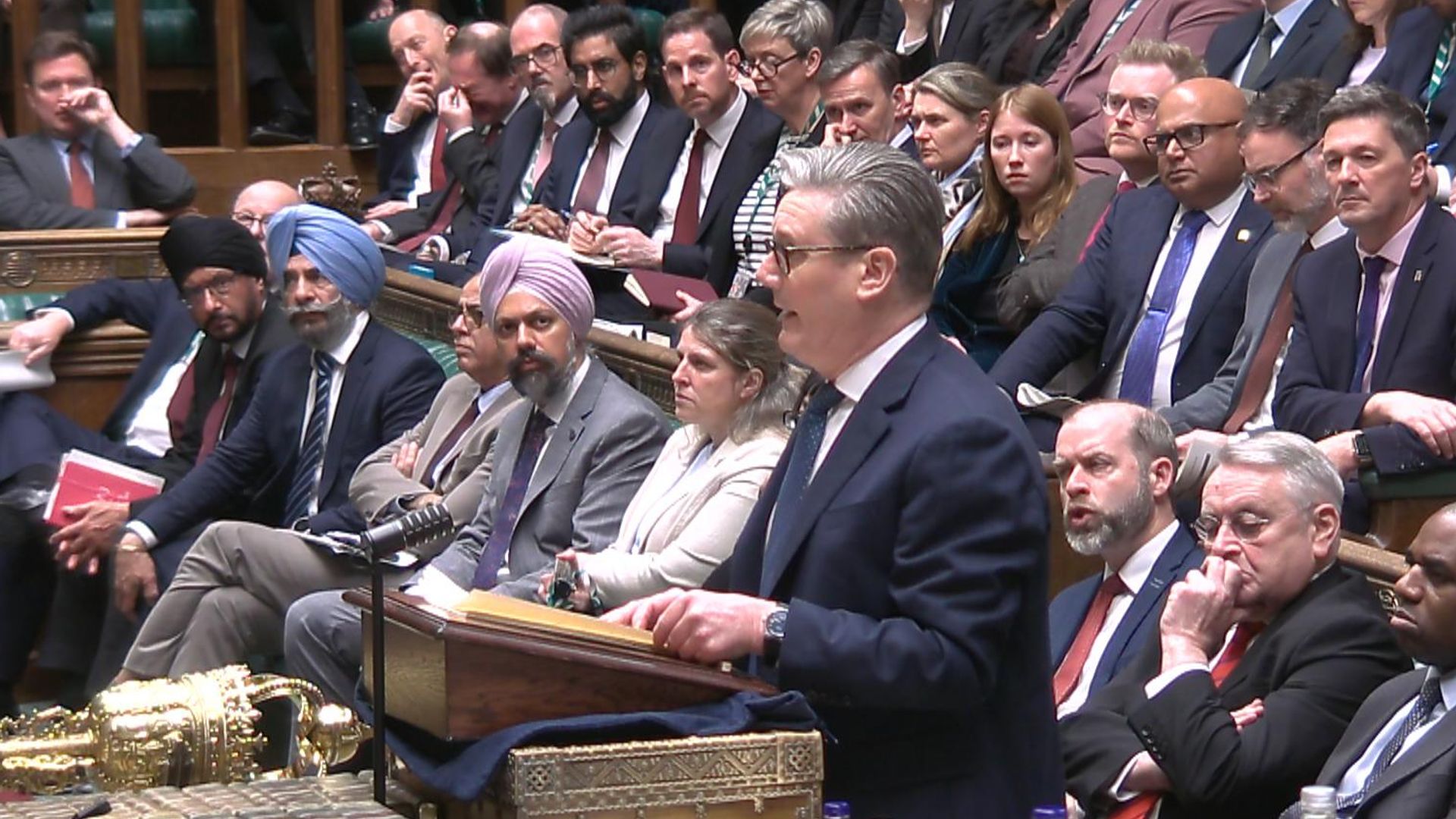
Keir Starmer has made a high-stakes gamble by distancing the United Kingdom from direct military strikes against Iran. While the United States and Israel ramp up kinetic operations to dismantle Tehran’s drone and missile infrastructure, Downing Street has chosen a path of strategic restraint. This is not a lapse in the "special relationship" or a sign of British military atrophy. It is a cold, deliberate calculation aimed at preserving the UK’s remaining influence in the Middle East while avoiding a domestic political firestorm that could derail the Labour government’s fragile honeymoon period.
By refusing to join the latest wave of aerial offensives, Starmer is signaling a departure from the interventionist shadows of the Blair era. He knows that the British public has little appetite for another open-ended conflict in the Gulf. More importantly, his military advisers have warned that the Royal Air Force is currently stretched thin, with assets committed to Eastern Europe and the Red Sea. Participation would be symbolic at best and a logistical nightmare at worst.
The Mirage of Unified Force
The optics of a "united front" often mask a messy reality of conflicting national interests. Washington views Iran through the lens of global hegemony and the protection of oil transit routes. Israel views Iran as an existential threat that must be neutralized before it achieves nuclear breakout. London, however, views Iran as a regional spoiler that is best managed through a combination of targeted sanctions and back-channel diplomacy.
Starmer’s refusal to fly alongside American F-35s is a recognition that British interests do not perfectly align with the White House on this specific chessboard. The UK still maintains a diplomatic presence in Tehran that the U.S. lacks. Joining the strikes would have instantly incinerated those channels, leaving Britain blind in a region where it historically prides itself on having the best intelligence "humint" or human intelligence.
The Specter of 2003
Every decision Starmer makes regarding Middle Eastern intervention is haunted by the ghost of the Iraq War. He is acutely aware that the Labour Party’s identity was fractured for two decades by the decision to follow George W. Bush into a conflict based on flawed intelligence. By saying "no" to this specific intervention, Starmer is insulating his leadership from the "poodle" accusations that dogged his predecessors.
This isn't just about optics. It is about the legal threshold for war. Starmer, a former Director of Public Prosecutions, demands a level of legal justification that the current intelligence may not yet satisfy. For the UK to participate in strikes on sovereign Iranian soil, the government must argue that there is an "imminent threat" to British lives. Currently, the threat is categorized as "persistent" and "malign," but not necessarily imminent in a way that satisfies the high bar of international law as interpreted by the Cabinet Office.
Military Overstretch and the Reality of the RAF
While politicians talk about "standing shoulder to shoulder," the generals are looking at the hangars. The Royal Air Force is facing a readiness crisis. With a significant portion of the Typhoon fleet committed to policing NATO’s eastern flank against Russian incursions, and the Carrier Strike Group undergoing maintenance, Britain’s ability to sustain a meaningful contribution to a multi-front war with Iran is questionable.
The cost of a single Storm Shadow missile—Britain’s primary long-range strike weapon—is roughly £2 million. In an era of "fiscal black holes" and domestic austerity, Starmer cannot easily justify spending hundreds of millions on a weekend of sorties that might not even shift the strategic needle in Tehran. He is choosing to keep his powder dry for a scenario where British territory or direct maritime interests are the primary targets.
The Economic Counter-Argument
There is a school of thought within the Foreign Office that argues restraint is actually more dangerous. Proponents of this view suggest that by failing to join the U.S. and Israel, the UK is signaling weakness to the Islamic Revolutionary Guard Corps (IRGC). This perceived vacuum of will could embolden Iran-backed proxies, such as the Houthis in Yemen, to increase their attacks on British-linked shipping in the Bab al-Mandab Strait.
If insurance premiums for shipping continue to skyrocket because the UK refuses to project force, the "savings" from not going to war will be eaten alive by inflation at the petrol pump and the grocery store. Starmer is betting that he can manage the Houthi threat through the existing Operation Prosperity Guardian without escalating to direct strikes on the Iranian mainland. It is a razor-thin line to walk.
The Israel Factor
Starmer's relationship with the Netanyahu government is transactional at best. Unlike the Biden administration, which feels a deep, historical obligation to back Israeli security operations, Starmer’s Labour is under intense pressure from its own backbenchers to remain critical of Israeli military conduct in Gaza and Lebanon.
Joining Israel in strikes on Iran would be seen by a significant portion of the Labour base as an endorsement of the broader regional escalation. Starmer has calculated that the political cost of joining the strikes—potential cabinet resignations and a wave of protests—outweighs the benefit of a pat on the back from Jerusalem. He is prioritizing domestic stability over international military adventurism.
Intelligence as a Shield
The decision-making process in the Cabinet Office Briefing Rooms (COBR) has shifted. Historically, the UK relied heavily on "Signals Intelligence" (SIGINT) provided by the NSA. Today, there is a renewed emphasis on independent verification. Starmer has reportedly asked for a "clearer picture" of the secondary consequences of these strikes.
What happens the day after the missiles hit? If Iran retaliates by closing the Strait of Hormuz, through which 20% of the world’s liquefied natural gas passes, does the UK have a plan to keep the lights on? The U.S. is energy independent; the UK is not. This fundamental difference in energy security dictates a fundamental difference in military appetite.
The Proxy War Trap
Iran rarely fights its own battles directly. It operates through a "Ring of Fire"—a network of militias across Iraq, Syria, Lebanon, and Yemen. By striking the center of the web (Tehran), the US and Israel are attempting to kill the spider. Starmer’s advisers argue that killing the spider doesn't necessarily stop the web from vibrating. In fact, it might trigger a coordinated, decentralized wave of terror attacks across Europe.
British intelligence agencies, MI5 and MI6, are currently operating at their highest tempo in years to prevent "lone actor" attacks inspired by Middle Eastern tensions. A direct military involvement in Iran would likely shift the threat level from "Substantial" to "Critical" overnight. Starmer is unwilling to trade a relatively stable domestic security environment for a tactical victory in the Iranian desert.
The Role of European Allies
Britain is also looking toward its neighbors. France and Germany have shown zero interest in joining a kinetic campaign against Iran. If the UK joined the US, it would once again find itself isolated from the European diplomatic consensus. Starmer is keen to rebuild ties with Brussels and Paris; being the "junior partner" in an American-led war is not the way to achieve that.
By staying out, the UK positions itself as the "reasonable" Western power. This allows Starmer to play the role of the mediator in the United Nations Security Council, a position that carries more weight than being just another voice in a bombing coalition. It is a play for "Soft Power" in a world increasingly dominated by "Hard Power."
Logistics of the Decision
$P_{risk} > B_{strategic}$
In the simplified logic of the Prime Minister’s inner circle, the probability of risk ($P_{risk}$) currently outweighs the perceived strategic benefit ($B_{strategic}$). The risk includes:
- A surge in domestic radicalization.
- Retaliatory cyber-attacks on the UK’s aging National Grid and banking infrastructure.
- A permanent rupture in diplomatic relations with a major regional power.
The benefit—degrading a few dozen drone factories—is seen as temporary. Iran has proven it can rebuild its low-tech, high-impact weaponry faster than the West can manufacture the high-tech missiles used to destroy them. It is an asymmetrical war that Starmer believes cannot be won from 30,000 feet.
The Silent Partnership
It would be a mistake to assume the UK is doing nothing. While Starmer has declined the "loud" military option, the UK is deeply involved in the "quiet" war. This includes:
- Financial Intelligence: Working with the City of London to freeze the assets of IRGC front companies.
- Cyber Offensive Operations: Using the National Cyber Force to disrupt Iranian command and control systems without firing a single physical shot.
- Maritime Interdiction: Increasing the boarding of vessels in the Arabian Sea suspected of smuggling Iranian components to the Houthis.
This "middle way" allows Starmer to claim he is taking action without having to face the political and legal consequences of a declared war. It is a pragmatic, if uninspiring, approach to a crisis that has no clean solutions.
The Prime Minister is gambling that the public will prefer a leader who avoids unnecessary wars over one who seeks "glory" on the international stage. He is betting that the UK can remain a global player without being a global policeman. Whether this restraint is seen as wisdom or weakness will depend entirely on how Tehran chooses to respond to the vacuum left by the British absence. If the region descends into a total conflagration, the "quiet" approach may look like a catastrophic failure of leadership. For now, Starmer is holding his breath and keeping his jets on the tarmac.
Ask the Ministry of Defence for a briefing on the current readiness of the UK's carrier strike groups.