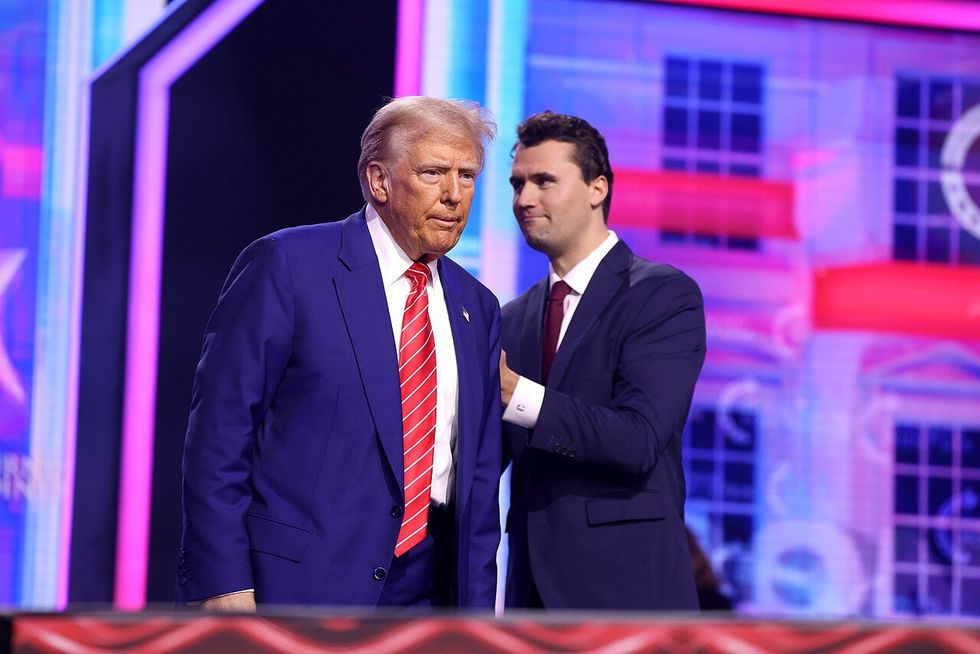
The air inside the donor suites and the green rooms of the American Right usually smells of expensive leather and the ozone of high-definition television cameras. It is a world of absolute certainty. Or, at least, it was.
Lately, that certainty has developed a hairline fracture.
If you look closely at the digital front lines where the MAGA movement breathes, eats, and fights, you’ll see the ripples of a localized explosion. The shrapnel isn't coming from the left this time. It is coming from within. At the center of the smoke stands Charlie Kirk, the face of Turning Point USA, a man who has spent a decade building a bridge between campus culture wars and the highest echelons of Mar-a-Lago. But that bridge is currently being pelted by the very people who helped pave it.
The catalyst wasn’t a new policy shift or a legislative failure. It was the ghosts of digital past.
The Sound of an Echo
Imagine a high-stakes poker game where everyone at the table has spent years claiming to play for the same team. Suddenly, one player leans over and flips a recording onto the felt. The recording is old, the voice is familiar, and the words are—depending on who you ask—either a momentary lapse in judgment or a confession of true character.
This is the reality of the "resurfaced comment" in the age of total digital memory. For Kirk, the comments in question touched on the sensitive, often jagged edges of identity politics and the strategic direction of the Republican party. To his detractors within the movement, these clips are proof of a "grifter" who says whatever the donor class wants to hear. To his defenders, they are ancient history being weaponized by jealous rivals.
But the "what" matters less than the "why."
Why now? Why are the most vocal allies of Donald Trump turning their bayonets inward when the general election looms like a thunderstorm on the horizon?
To understand the friction, you have to understand the ecosystem. The MAGA movement is not a monolith; it is a sprawling, chaotic coalition of traditional conservatives, populist firebrands, "online-first" influencers, and old-school power brokers. For years, the gravity of Trump’s personality held these disparate atoms together. Now, as the movement matures, the internal competition for the "True Believer" crown has become a blood sport.
The Architecture of the In-Fight
Consider the hypothetical case of a precinct committeeman in Ohio. Let’s call him Jim. Jim has spent eight years wearing the hat, knocking on doors, and listening to Charlie Kirk’s podcasts while he drives his truck. To Jim, Kirk was the vanguard—the guy who wasn’t afraid to go into the "lion's den" of a university campus and argue for Western values.
Then Jim opens his phone. He sees a barrage of posts from other influencers he trusts—people like Laura Loomer or disgruntled former Turning Point staff—claiming that Kirk is a "RINO" in wolf’s clothing. He sees clips of Kirk from five years ago saying things that sound suspiciously like the "establishment" talking points Jim hates.
Jim is confused. His loyalty is being pulled in two directions. This isn't just a spat between two talking heads in D.C. It’s a crisis of identity for the person in the pews. When the gatekeepers start burning each other's houses down, the people living in the village start wondering who is actually left to lead the defense.
The stakes are invisible but massive. This infighting represents a struggle for the soul of the GOP’s ground game. Turning Point USA has positioned itself as the primary engine for youth mobilization. If that engine is perceived as tainted or "insufficiently MAGA," the entire voter-outreach strategy for 2024 begins to wobble.
The Currency of Purity
In the modern political arena, the most valuable currency isn't money. It’s purity.
Every movement has its puritans—the people who believe that any compromise is a betrayal. Within the Trump coalition, there is a growing faction that views any historical deviation from the current "America First" line as an unpardonable sin. They are the digital inquisitors, and they are currently looking at Charlie Kirk’s past statements through a magnifying glass.
The irony is thick. The very tactics that the MAGA movement used to disrupt the "Mainstream Media"—digging up old clips, highlighting hypocrisy, and using viral outrage to deplatform opponents—are now being used by the movement's own members against their own leaders.
It is a circular firing squad with a livestream.
But beneath the accusations of "grifting" lies a much deeper, more human fear. There is a terrifying realization among the grassroots that the people they’ve entrusted with their movement might not actually believe the things they say. It’s the fear of being used. When a resurfaced comment shows a leader speaking a different language to a different audience, it shatters the illusion of the "warrior" and replaces it with the image of the "politician."
Nothing kills a populist movement faster than the smell of a politician.
The Shadow of Mar-a-Lago
Everything in this world eventually circles back to one man. Donald Trump is the sun around which all these planets orbit. In the past, he has acted as the ultimate arbiter. If he invites you to the stage, you are "in." If he ignores you, you are "out."
The current Kirk controversy is a desperate play for the President's ear. The rivals dumping these clips aren't just trying to win a Twitter argument; they are trying to convince the man at the top that his current advisors are liabilities. They are trying to clear the field.
It’s a Shakespearean drama played out in 280-character bursts. It’s King Lear, but with ring lights and "Don't Tread on Me" flags.
The danger for the movement is that while the captains are fighting over who gets to stand closest to the King, the soldiers in the field are getting tired. Politics is a game of momentum, and momentum is fueled by unity of purpose. When the message becomes a messy internal debate about who said what in 2018, the message to the undecided voter in Pennsylvania or Arizona gets lost in the noise.
The Human Cost of Constant War
We often talk about these events as if they are abstract data points in a "news cycle." But for the people involved, and the millions who follow them, the toll is real.
There is a specific kind of exhaustion that comes from being in a state of perpetual outrage. When you wake up every day and have to check which of your "heroes" is a "traitor" today, the world starts to feel like a very small, very hostile place. The trust that holds a community together—even a political one—begins to dissolve into cynicism.
"If I can't trust the guy who founded the biggest youth organization in the country," a donor might ask, "who can I trust?"
The answer, increasingly, is "nobody." And a movement built on "nobody" is a movement that cannot build anything permanent. It can only tear down.
The Kirk controversy isn't just about Charlie Kirk. It’s about the fragility of a movement that has prioritized loyalty over institutions. When you have no institutions, only personalities, the moment a personality is tarnished, the whole structure shakes.
The Mirror's Edge
As the sun sets over the next campaign stop, the microphones will be tested, the crowds will gather, and the slogans will be shouted with the same vigor as before. But the participants will be looking at each other a little more sideways than they did last month.
They are realizing that the digital footprints they leave today are the landmines of tomorrow. They are realizing that in a world where everything is recorded, there is no such thing as a "private" growth or a "changed" mind. There is only the clip.
The infighting will likely subside, or it will find a new target. That is the nature of the beast. But the cracks in the mirror remain. Every time a new clip surfaces, every time a "loyal ally" turns into a "bitter rival," the reflection of the movement becomes a little more distorted.
The people at the top will continue to play their games of throne and influence. They will issue press releases and go on friendly podcasts to "set the record straight." They will claim the movement has never been stronger.
But in the quiet moments between the rallies, when the cameras are off and the smartphones are charging, there is a nagging question that remains. It’s the question that haunts every revolution, every uprising, and every populist surge.
What happens when there is no one left to purge?
The answer is usually silence. And in politics, silence is the one thing no one can survive.
A man stands on a stage, bathed in the white heat of a spotlight, telling thousands of people exactly what they want to hear. In his pocket, a phone is buzzing with a notification of a video he hasn't seen in seven years. He smiles. He waves. He hopes the lights are bright enough to hide the sweat on his brow.