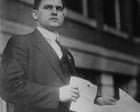
The air in Milwaukee on the night of October 14, 1912, smelled of lake mist and political desperation. Theodore Roosevelt was tired. He was fifty-three years old, an age when most men of his era were settling into the quiet comfort of a library chair, but Roosevelt was currently tearing the country in two. He had bolted from the Republican Party to lead the "Bull Moose" Progressives, a move that felt less like a campaign and more like a crusade.
He stepped out of the Hotel Gilpatrick and into an open-top car. The crowd pressed in. A man named John Schrank was among them. Schrank wasn't a titan of industry or a rival politician; he was a saloonkeeper with a haunting vision that the ghost of William McKinley had told him to kill the man who succeeded him. As Roosevelt stood to wave his hat, Schrank leveled a .38-caliber Colt revolver and pulled the trigger at point-blank range.
The flash was bright. The sound was a sharp crack that momentarily silenced the cheering. Roosevelt didn't fall. He didn't even scream. He simply reached inside his heavy overcoat, felt the warmth spreading across his ribs, and told the driver to head to the Milwaukee Auditorium. He had a speech to give.
The Shield Made of Words
We often think of history as a series of grand, sweeping movements—wars, treaties, and elections. But history is frequently decided by the physics of small things. In this case, Roosevelt’s life was saved by fifty sheets of paper and a spectacle case.
Roosevelt was a man of immense preparation. His speech that night, titled "Progressive Cause Greater Than Any Individual," was a monster. It was fifty pages of heavy bond paper, folded once and tucked into his breast pocket. Right next to it sat a metal case containing his steel-rimmed spectacles. When Schrank’s bullet struck Roosevelt’s chest, it didn't find soft tissue first. It hit the metal. It tore through fifty layers of dense, folded prose.
The bullet slowed. It struggled. By the time it exited the back of the manuscript and entered Roosevelt’s body, it had lost the lethal velocity required to reach his heart or lungs. It lodged itself in his chest wall, coming to rest against a rib.
Inside the auditorium, the atmosphere was electric and confused. Roosevelt walked onto the stage, his face pale, his stride steady. He looked at the crowd of ten thousand people and waited for the noise to die down. Then, he spoke the words that would become legend.
"Friends, I shall ask you to be as quiet as possible. I don't know whether you fully understand that I have just been shot; but it takes more than that to kill a Bull Moose."
He unbuttoned his vest. The audience gasped. His white shirt was crimson, soaked through with a bloom of blood that was still widening. To prove his point, he held up the manuscript. The crowd could see the jagged, blackened hole punched clean through the center of his ideas.
The Physics of Persuasion
There is something deeply poetic about a man being saved by the weight of his own words. If Roosevelt had been a man of brevity—if he had written a lean, five-page address—he would have died in that car. His verbosity was his armor.
For ninety minutes, he spoke. He didn't just talk about policy; he spoke about the insignificance of his own life compared to the survival of the American experiment. His doctors pleaded with him to stop. They hovered in the wings, frantic, watching the red stain on his chest grow. Roosevelt ignored them. He understood a fundamental truth about leadership: the image of the wound is often more powerful than the wound itself.
He finished the speech. Only then did he allow himself to be taken to the hospital. X-rays later showed the bullet nestled in his chest, too dangerous to remove. He would carry that ounce of lead inside him for the rest of his life, a permanent passenger from a Milwaukee street corner.
But the physical evidence of that night—the tangible remains of a miracle—went missing or remained hidden in private collections for decades. We knew the story, but we lacked the artifact.
The Uncovered Page
Recently, a specific page from that blood-stained manuscript surfaced, emerging from the fog of time like a ghost. It is a single sheet of paper, yellowed by a century of oxygen and light, bearing the physical trauma of the assassination attempt. To hold it—or even to look at it—is to feel the terrifying thinness of the line between life and death.
The hole is not clean. It is a violent, shredded puncture. The fibers of the paper are blown outward, scorched by the heat of the projectile. It is a reminder that the "Great Man" theory of history often rests on the durability of a piece of stationery.
This page represents more than just a souvenir of a crime. It is a testament to the sheer, stubborn will of a man who refused to let his mortality interrupt his mission. In our modern era of digital transparency and instant communication, we rarely see such physical manifestations of conviction. We see tweets; we don't see blood-soaked manuscripts.
Consider the reality of that moment for Roosevelt. He was an experienced hunter. He knew what a bullet did to a body. He knew he was bleeding, and he likely knew he could be dying of internal hemorrhaging as he stood behind that podium. Yet, he chose to use the final minutes of his life—as he believed they might be—to defend a set of principles.
The Echo in the Archive
The discovery of this page forces us to reckon with the visceral nature of the past. It strips away the polished marble of the monuments and the dry ink of the textbooks. It reminds us that the people who built our world were made of bone and blood, and that they were terrified just as often as they were brave.
John Schrank, the shooter, was eventually found insane and spent the rest of his life in an asylum. He never showed remorse. He believed he had done what the ghost asked of him. Roosevelt, meanwhile, lost the election to Woodrow Wilson, but he won something far more enduring. He proved that a person's spirit could be more resilient than their flesh.
The bullet remained in his ribs until his death in 1919. It was a constant, dull ache, a reminder of the night in Milwaukee when time almost stopped.
When we look at the newly uncovered page of that speech, we aren't just looking at a historical document. We are looking at the exact point where a madman’s bullet met a leader’s resolve. The paper is torn, the ink is faded, and the man is long gone. But the hole remains—a silent, jagged window into a moment when the history of the world hung on the thickness of a few dozen pages.
Roosevelt later said that he didn't feel any particularly grand emotion when he was hit. He said it felt like being kicked by a horse. But as he stood on that stage, clutching those shredded papers, he wasn't a politician anymore. He was a man who had looked into the dark and decided he wasn't finished yet.
The page sits under glass now, silent and still. It is just paper. It is just a hole. But it is also the reason the 20th century looks the way it does.


