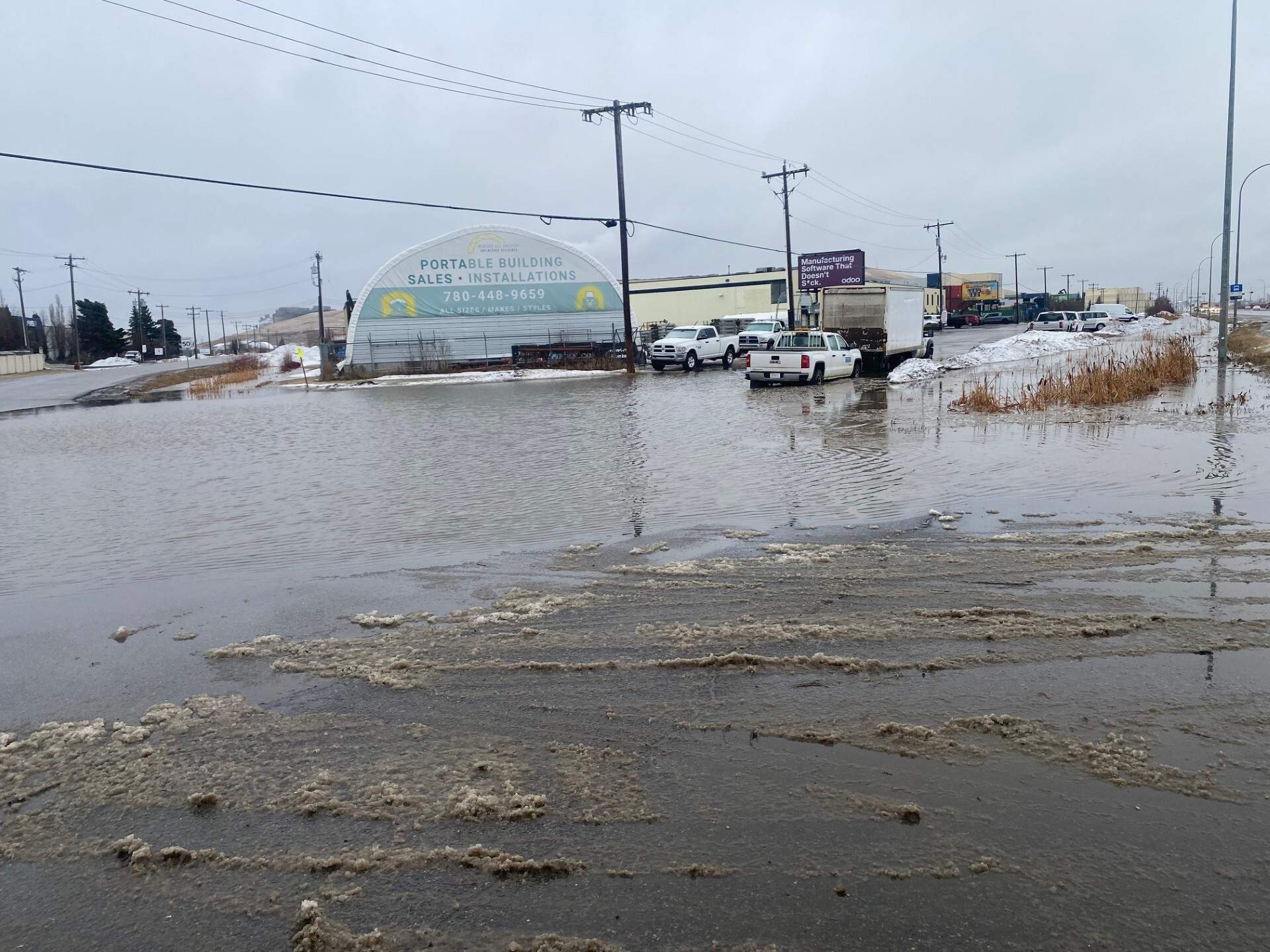
Stop blaming the city for your basement.
The recent outcry from Edmonton business owners regarding decades-long drainage issues isn't a story about failing infrastructure. It is a story about failing due diligence. We have become a culture of "rent-seekers" who expect the municipal taxpayer to subsidize the physical risk of our private investments.
When a business in a low-lying area of a city like Edmonton—a city built on a glacial lakebed with a notorious history of heavy "Plowman" storms—deals with water in the lobby for thirty years, the problem isn't the sewer pipe. The problem is the lease.
The Myth of the "Infra-Fix"
The common consensus is lazy: "The city needs to upgrade the pipes to handle 1-in-100-year events."
This logic is flawed because it ignores the physical reality of urban hydrology. You cannot out-pipe a cloudburst in a concrete jungle. In a typical urban setting, the runoff coefficient for a parking lot is nearly 0.95. This means 95% of the water that hits that surface stays on top of it.
When you shove that volume into a legacy "combined" sewer system, the physics of fluid dynamics dictates that the water will find the path of least resistance. Often, that path is through a business owner’s floor drain. To "fix" this at a city-wide scale would require tearing up every arterial road in the city at a cost that would bankrupt the municipal tax base.
Investing in a business located in a topographical bowl and then complaining that it gets wet is like buying a house on a cliffside and acting shocked when the soil erodes. You didn't buy a "drainage problem." You bought a "water feature" you didn't want.
The Due Diligence Deficit
I’ve seen developers blow millions on "prime" real estate because they looked at the foot traffic but ignored the LIDAR maps. If you are signing a ten-year commercial lease, and you haven't checked the elevation of your finished floor relative to the 100-year flood plain, you aren't an entrepreneur. You’re a gambler who doesn't understand the odds.
The "passing the buck" narrative usually targets the City of Edmonton’s EPCOR transition or the lack of federal grants. This is a distraction.
- Topography is Destiny: Water moves from high potential energy to low potential energy. If your business is at the bottom of the hill, you are the drainage system.
- Liability vs. Responsibility: The city has a duty to maintain the public right-of-way. They do not have a duty to ensure your private basement stays dry in a climate that is increasingly volatile.
- The Insurance Trap: Business owners rely on overland flood insurance as a crutch. But insurance is for the "unforeseen." If it happens every three years, it isn't an accident; it’s an operating cost.
Stop Asking the City for Pipes; Start Asking for Pavement
The "People Also Ask" sections of the internet are filled with questions like, "How can the city improve drainage?"
Wrong question.
The right question is: "Why are we still allowing 100% site coverage with impermeable surfaces?"
If we want to stop the flooding, we have to stop the runoff. This is where the contrarian view gets uncomfortable for the very business owners complaining. To solve the drainage crisis, we must mandate that every private lot manages its own "first flush"—the first 15 to 25 millimeters of rain.
This means:
- Replacing those "essential" parking stalls with permeable pavers.
- Installing bioswales that take up valuable storefront space.
- Investing $50,000 in a private cistern system rather than a new sign.
Business owners want the city to spend $500 million of public money so they don't have to spend $50,000 of their own. It is a classic case of privatizing the profits and socializing the risks.
The Engineering Reality: $Q = CiA$
In the world of civil engineering, we use the Rational Method to calculate peak discharge: $Q = CiA$.
- $Q$ is the peak rate of runoff.
- $C$ is the runoff coefficient.
- $i$ is the rainfall intensity.
- $A$ is the drainage area.
The city cannot control $i$ (the rain) or $A$ (the size of the neighborhood). They can only barely influence $C$ through zoning. If you are a business owner, you are the master of $C$ on your own property. If your $C$ is 0.90 because you’ve paved every square inch, you are the reason your neighbor is flooded, and you are the reason you are flooded.
The Hard Truth of Managed Retreat
There are parts of every city—Edmonton included—where the cost to "fix" the drainage exceeds the total property value of the businesses being protected. In any other industry, we would call this a "stranded asset."
We need to stop the "heroic engineering" mindset. Sometimes, the answer isn't a bigger pipe; it's a "For Lease" sign and a moving truck. If a location has flooded four times in twenty years, that location is no longer viable for high-value inventory or sensitive equipment.
The industry insider secret? The city knows this. They won't say it because it kills the tax base and invites lawsuits. But they are waiting for you to give up so they can turn that low-lying area into a "dry pond" or a park—which is what it should have been in the first place.
The 3-Step Disruptive Strategy for Flood-Prone Businesses
If you are currently "dealing" with a drainage problem, stop writing letters to your city councilor. They can’t fight gravity.
First, conduct a Private Hydro-Audit. Hire a private firm to map the specific ingress points of your building. Most "sewer backups" are actually failures of the building’s own internal plumbing or foundation sealing. If your backwater valve isn't industrial grade and maintained annually, the fault lies with your facilities manager, not the utility provider.
Second, aggressively negotiate "Flood Rent." If the city won't fix the pipes, the landlord must fix the price. A flood-prone building is a defective product. You should be paying 30% below market rate to compensate for the intermittent business interruption and the cost of private mitigation. If the landlord won't budge, leave.
Third, invest in "Sacrificial Architecture." Stop putting drywall in your basement. Stop putting carpet in the lobby. Use polished concrete, stainless steel, and waterproof membranes. Design your business to be hosed out in four hours. If you can't stop the water, make the water irrelevant.
The "victim" narrative is for people who don't understand their own balance sheet. In a world of shifting weather patterns, a "drainage problem" is just a polite way of saying you have a bad location.
Own your site or the site will eventually own you.


-01.png)