The air in central London usually smells of diesel exhaust and expensive roasted coffee. But on this Sunday afternoon, the atmosphere shifted. It became thick with something sharper. Acrid. It was the scent of adrenaline and old, deep-seated grievances rising from the asphalt of Park Lane.
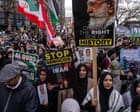
You could hear the divide before you saw it. To the left, the rhythmic, booming chants of the Al-Quds Day marchers, a sea of flags and banners moving with a singular, practiced momentum. To the right, the jagged, reactive roar of the counter-protest. Between them stood a thin, fluorescent line of Metropolitan Police officers, their faces etched with the weary neutrality of people paid to stand in the crossfire of history.
This wasn't just a logistical headache for Transport for London. It was a pressure cooker. When the lid finally blew, it didn't happen with a cinematic explosion. It happened in small, ugly bursts of friction—the kind that ends with the metallic click of handcuffs and the heavy thud of a police van door.
The Human Cost of a Standoff
Consider a young officer, let's call him James. He isn’t a political theorist. He is a twenty-four-year-old from Surrey who skipped breakfast because his shift started at dawn. As the crowds converged near the Dorchester Hotel, James found himself leaning his weight against a metal barricade, his palms sweaty inside black tactical gloves.
On one side of the metal, a woman screamed about liberation, her voice cracking with a desperation that felt visceral. On the other, a man draped in a different flag spat insults that were older than the city itself. For James, the "invisible stakes" aren't about international treaties or border disputes. They are about the three inches of space between his chest and a shouting stranger.
By the time the sun began to dip behind the grand townhouses of Mayfair, twelve people had been stripped of their Sunday plans and taken into custody.
The numbers are easy to skim in a headline. Twelve arrests. It sounds tidy. It sounds like the system is working. But the reality is a chaotic sequence of split-second decisions. One man was tackled for an offensive placard—a piece of cardboard that transformed from a political statement into a criminal exhibit the moment it crossed a legal threshold. Another was detained for breach of the peace. Then came the accusations of assault.
The Anatomy of the Breaking Point
Why does a city that prides itself on "Keep Calm and Carry On" find itself fractured so regularly? To understand the twelve arrests, you have to look at the psychological architecture of a protest.
When you join a crowd, your individual identity begins to blur. You aren't just a teacher, a shopkeeper, or a student anymore. You are a cell in a larger organism. This collective energy is intoxicating. It provides a sense of belonging that is rare in our digital, isolated lives. But that same energy has a dark side. It lowers the threshold for aggression.
The Metropolitan Police had deployed a "significant" presence, a phrase that translates to hundreds of officers pulled from their local boroughs to stand in the cold. They used Section 14 of the Public Order Act, a legal tool that allows them to dictate exactly where people can stand and for how long. It is a delicate dance. If the police are too hands-off, the two groups clash and the streets turn into a mosh pit of violence. If they are too heavy-handed, they become the villains of the narrative, fueling the very anger they are trying to contain.
The arrests weren't distributed equally across the afternoon. They happened in clusters. A spark here, a shove there.
One particular arrest involved a man who refused to move from a restricted area. In his mind, he was a martyr for a cause, standing his ground against an oppressive state. To the officer tugging at his arm, he was a "10-16"—a person to be processed, a paperwork trail that would last long into the night. This disconnect is where the tragedy lies. We are no longer speaking the same language. We are shouting across a chasm of misunderstood intentions.
The Invisible Lines in the Sand
We often think of London as a playground for the wealthy or a hub for global finance. But on days like this, the city reveals its true nature: it is a palimpsest, a place where layers of history are constantly being overwritten but never fully erased.
The Al-Quds Day rally is an annual event, a fixture of the post-Ramadan calendar. It is inherently provocative to its detractors. The counter-protest is equally inevitable. This isn't a new story. What is new is the intensity. The digital world has stripped away the nuance, leaving only the sharp edges of "us" versus "them."
As the marchers moved toward Whitehall, the tension didn't dissipate; it just migrated. The police had to keep the "bubble" intact. Every time a counter-protester tried to pierce that bubble, the friction spiked.
Imagine the paperwork. For every one of those twelve arrests, an officer has to sit in a windowless room at a station like Charing Cross or Brixton, recounting the exact moment the law was broken. They have to justify the use of force. They have to categorize the anger. Was it a hate crime? Was it a simple obstruction? The legal system tries to impose order on a situation that was, by its very definition, disorderly.
The Echo in the Silence
By 7:00 PM, the barricades were being stacked onto flatbed trucks. The discarded placards—brightly colored slogans now sodden with rain and grime—lay in the gutters. The crowds had thinned, heading to the Underground or back to the suburbs, their throats sore, their hearts still thumping.
But the city doesn't just reset.
The twelve people in cells are now part of a statistic, but they are also neighbors, sons, and daughters. Their families are waiting for a phone call. Their employers will ask questions on Monday morning. The ripples of a three-minute scuffle on a London sidewalk extend for months, through court hearings and legal fees and fractured reputations.
We tend to look at these events as isolated incidents, like weather patterns that pass through. But they are symptoms. They are the visible bruises on a body politic that is struggling to breathe.
Standing on Park Lane as the last of the police vans drove away, the silence was almost deafening. The grand hotels were lit up again, their doormen returning to the business of opening doors for tourists who had watched the chaos from behind reinforced glass. The "dry facts" tell us that twelve people were arrested. The truth tells us that thousands of people went home feeling more divided, more unheard, and more entrenched than they were when they woke up.
The pavement is cleared. The traffic is flowing again. But the cracks in the foundation remain, hidden just beneath the surface, waiting for the next time the temperature rises.
The real story isn't the handcuffs. It's the fact that we've forgotten how to stand on the same street without them.