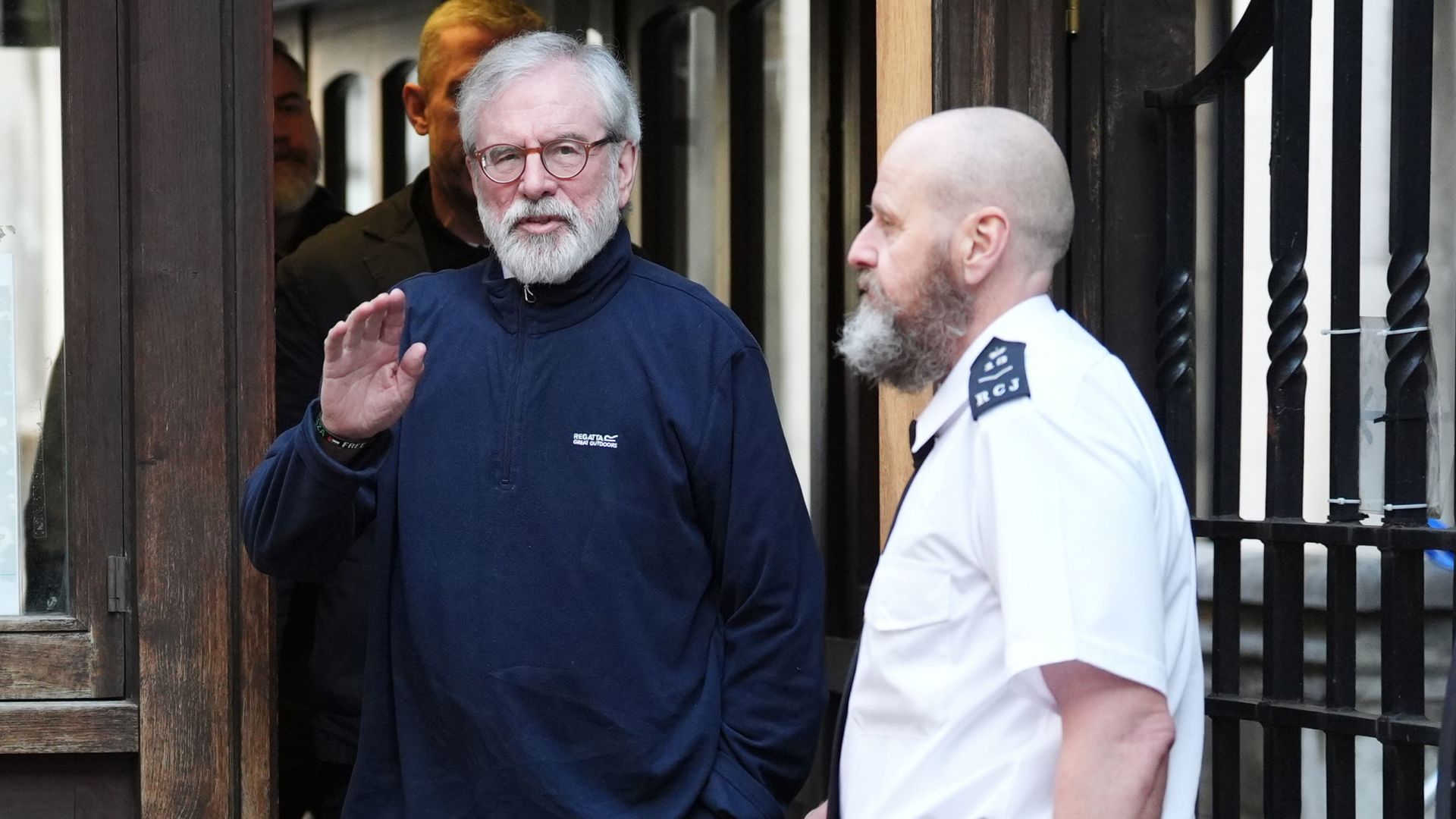
The aging figure in the witness box of the Royal Courts of Justice carried the weight of a conflict that supposedly ended nearly thirty years ago. Gerry Adams, the former president of Sinn Féin, arrived in London this March to face a civil trial that is less about money and more about the soul of Irish history. Three survivors of Provisional IRA bombings in London and Manchester are suing Adams for a symbolic £1, alleging he was a high-ranking commander who directed the campaigns that shattered their lives. Adams, now 77, remains steadfast in his decades-long denial of ever being a member of the IRA, using the trial to assert the "legitimacy of the republican cause" while dismissing the evidence against him as "unsubstantiated hearsay."
This legal confrontation represents a high-stakes attempt to do what decades of criminal investigations and political treaties could not: fix a definitive label of "IRA commander" onto the man who helped negotiate the Good Friday Agreement. Because this is a civil case, the burden of proof is not "beyond a reasonable doubt," but the lower threshold of the "balance of probabilities." For the claimants—John Clark, Jonathan Ganesh, and Barry Laycock—the goal is a court-sanctioned acknowledgement of the "common design" they say Adams shared with the bombers.
The Architecture of Denial
For over fifty years, Gerry Adams has maintained a carefully curated distance between his political activism and the paramilitary violence of the Provisional IRA. In court, he repeated the familiar refrain that Sinn Féin and the IRA were entirely separate entities. He spoke of his 60 years as a "political activist," rejecting the suggestion by Sir Max Hill KC that he and Martin McGuinness were "volunteers turned politicians."
The defense strategy rests on the massive time gap between the events and the trial. The bombings in question occurred in 1973 (the Old Bailey) and 1996 (Docklands and Manchester). Adams’s legal team argued that such a delay is "unprecedented in magnitude" and constitutes an abuse of the court system. They contend the trial is being used as a "public inquiry" by proxy, rather than a focused legal claim.
Yet, the prosecution presented what they called a "jigsaw" of evidence. This included testimony from former British intelligence officers and, crucially, former IRA volunteers. Two anonymous intelligence witnesses, known only as Witness A and Witness B, testified that the British, Irish, and American governments only dealt with Adams because they were certain of his senior rank within the IRA Army Council. The logic is simple: why would world powers negotiate a ceasefire with a man who had no control over the guns?
The Legitimacy Argument
Outside the courtroom, Adams was more expansive, framing his appearance as a defense of the Irish people's right to self-determination. He spoke of the "bad experience" Irish republicans have historically had with British courts. This is a calculated move to shift the narrative from personal culpability to a broader historical struggle against "armed British occupation."
Adams told the court he does not defend every action the IRA took—labeling some "dastardly"—but he refuses to distance himself from the movement. This "foot in each camp" approach was a hallmark of his leadership during the Troubles. It allowed him to maintain the loyalty of the hardline "volunteers" while wearing the suit of a diplomat in Washington and London.
A Symbolic Pound and the Weight of History
The demand for a single pound in damages highlights the purely "vindicatory" nature of the lawsuit. The claimants aren't looking for a payout; they are looking for a verdict. They seek to prove that Adams was "so intrinsically involved" in the Provisional IRA that he is as legally responsible as the individuals who physically planted the devices.
The evidence presented by the victims' legal team relied heavily on the "common design" principle. They argued that the 1990s bombing campaign in England could not have happened without the direct authorization of the seven-man Army Council, a body they allege Adams led.
Adams countered this by highlighting his role in the peace process. He argued that during the mid-90s, he was entirely focused on securing a "permanent end to the conflict." To his supporters, the trial is a "campaign of demonization" by a British establishment that has never forgiven him for his success. To his detractors, his presence in the London court is a long-overdue moment of accountability for a man who they believe has successfully "laundered" a violent past into a respectable political present.
The Missing Truth Process
The trial exposes the gaping hole where a formal "truth and reconciliation" process should be in Northern Ireland. Because no such mechanism exists, victims are forced into the adversarial arena of civil litigation to seek answers. Adams himself pointed this out, claiming he has long advocated for a truth process where all parties—including the British state—would have to account for their actions.
However, critics argue that Adams's own refusal to admit IRA membership is the biggest obstacle to such a process. If the primary architect of the peace refuses to acknowledge his alleged role in the war, the "truth" remains a moving target.
The proceedings in London have been characterized by testy exchanges over historical symbols. When questioned about wearing a black beret—a symbol of IRA membership—at republican funerals, Adams replied with visible frustration that he had answered that question "at least 10 times." This friction reflects the broader tension of the trial: a clash between the clinical requirements of the law and the messy, emotional reality of a sectarian conflict.
The Legacy of the Army Council
The trial's focus on the IRA Army Council is a direct challenge to the "Sinn Féin and the IRA were separate" narrative. If the court finds, on the balance of probabilities, that Adams sat on that council, the political implications for Sinn Féin—now a major power in both the North and the Republic of Ireland—are significant. It would tie the modern, electoral success of the party directly to the command structure of the 1996 bombing campaign.
The testimony of Witness B was particularly pointed. He suggested that if Adams wasn't the senior figure everyone believed him to be, he had pulled off a "remarkable coup" by fooling three different world governments for decades. This hits at the heart of the "Adams Enigma."
The legal team for the victims aims to strip away the ambiguity. They are pushing the court to declare that the political and military wings were two sides of the same coin, and that Gerry Adams held the coin. As the trial draws to a close, the focus remains on whether the "hearsay" and "intelligence" gathered over decades can finally coalesce into a legal fact.
The outcome of this case will not result in a prison sentence, nor will it bankrupt the former Sinn Féin leader. But a ruling against him would fundamentally alter the historical record of the peace process. It would transform Adams from the "peacemaker who knew the gunmen" into the "gunman who made peace." For the three men who survived the blasts at the Old Bailey, the Docklands, and Manchester, that distinction is the only thing that matters.