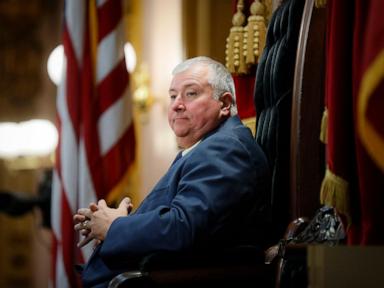
The air inside the House Chamber of the United States Capitol usually carries the scent of old wood, floor wax, and the heavy, electric friction of opposing ideologies. It is a room built for argument. For centuries, its walls have absorbed the echoes of shouted disagreements and the sharp, rhythmic crack of the gavel. But today, the atmosphere shifted. The silence was different. It wasn’t the tense quiet before a political storm, but the expectant hush that precedes an attempt at something far more fragile: grace.
When King Charles III stood before the joint session of Congress, he wasn't just a monarch in a bespoke suit. He was a man carrying the weight of a thousand-year-old crown into a temple of revolutionary democracy. The irony was thick enough to touch. Here was the successor of George III, the very sovereign against whom the men in these paintings had rebelled, standing on the pulse-point of American power.
He didn't come to lecture. He came to speak of "reconciliation and renewal."
Those words can often feel like hollow shells, the kind of polished pebbles politicians throw into the sea of public discourse. But as the King began to speak, the cadence of his voice suggested something deeper. He was addressing a world that feels increasingly fractured—not just between nations, but within the very fabric of our own communities. He looked out at a room divided by aisles that often feel like canyons, and he chose to talk about the messy, painful, and ultimately necessary work of mending what is broken.
The Ghost in the Gallery
Consider a hypothetical spectator sitting in the gallery—let's call her Sarah. Sarah is a congressional staffer who has spent the last decade watching the vitriol rise like a tide. She has seen friendships end over policy papers and families stop speaking because of the news cycles. To her, "reconciliation" sounds like a fairy tale. It sounds like something that happens in dusty history books, not in the gritty reality of 2026.
But the King’s presence offered a living metaphor. The relationship between the United Kingdom and the United States is the ultimate case study in reconciliation. We started with musket fire and bitter resentment; we moved through colonial divorce and systemic upheaval. Yet, there he was. The King’s very existence in that chamber was proof that the "renewal" he spoke of isn't just a nice sentiment. It is a historical fact. It is possible for the most bitter of enemies to become the most indispensable of friends.
He spoke of the shared challenges that ignore borders. The climate, the rapid-fire evolution of artificial intelligence, and the preservation of democratic norms. These aren't just line items on a summit agenda. They are the invisible stakes of our era. If we cannot find a way to reconcile our internal differences, the King suggested, we will be ill-equipped to face the external storms that don't care which side of the aisle we sit on.
The Weight of the Crown
There is a specific kind of burden that comes with being a symbol rather than a legislator. While the people in front of him deal in the currency of the next election, Charles deals in the currency of the next century. His perspective is inherently long-term. This gave his words a haunting quality. When he spoke of "renewal," he wasn't talking about a policy shift or a budget adjustment. He was talking about a spiritual and cultural reboot.
He touched on the wounds of the past—acknowledging the complexities of empire and the shifting tides of global influence. It was a moment of vulnerability. To lead a monarchy in the modern age requires a constant, exhausting dance with history. You must honor the tradition while simultaneously apologizing for its excesses. You must be a bridge.
The King’s voice remained steady, but there was a palpable gravity when he mentioned the "indispensable bond" between the two nations. This isn't just about military treaties or trade agreements. It’s about a shared vocabulary of freedom. It’s about the belief that even when we fail—and we do fail, loudly and publicly—we have the mechanism to try again.
Beyond the Polished Phrases
The genius of the address lay in its refusal to offer easy answers. Reconciliation is hard. It requires the swallowing of pride. It demands that we look at our opponents and see something other than a villain. The King didn't pretend that a single speech could heal the divisions of the modern world. Instead, he offered a framework for how we might begin the work.
He used the analogy of a garden—a subject close to his heart. A garden requires constant attention. It needs the removal of weeds, the nourishing of the soil, and, most importantly, the patience to wait for things to grow. You cannot force a flower to bloom by shouting at it. You cannot mandate renewal. You have to create the conditions where it becomes possible.
As he spoke, the cameras caught glimpses of the lawmakers' faces. For a few moments, the partisan masks seemed to slip. There was a shared recognition of the stakes. Whether they agreed with the institution of monarchy or not, they couldn't deny the power of the message. In a world that feels like it’s pulling apart at every seam, the idea of weaving something back together is profoundly radical.
The Echo in the Halls
The speech ended not with a bang, but with a resonant call to action that felt more like a quiet plea. The King stepped back, the applause rose, and the heavy doors of the Chamber eventually swung open to let the world back in.
But the words lingered.
Outside the Capitol, the cherry blossoms were beginning to stir, a seasonal reminder of the very renewal the King had described. The tourists were snapping photos, the sirens were wailing in the distance, and the machinery of government was grinding back into gear.
The King's visit will be analyzed by pundits for its diplomatic implications. It will be carved up into soundbites for the evening news. But for those who were in the room, or for someone like Sarah watching from the gallery, the takeaway was something less clinical.
It was the realization that history isn't just something that happened to people in powdered wigs. It is something we are making right now, with every choice to listen instead of shout, and every effort to find common ground in a landscape of shifting sand. The crown and the Congress had met, and for a brief window of time, the conversation wasn't about power. It was about the possibility of starting over.
A hand extended across a centuries-old divide.
A bridge built out of words.
A reminder that even the deepest wounds can eventually become scars, and scars are just the skin's way of proving it has healed.