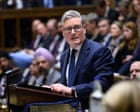
Keir Starmer is currently attempting to perform a delicate piece of political surgery on the soul of the Labour Party. He wants to excise the ghost of the Iraq War, a conflict that didn’t just ruin a prime minister’s reputation but fundamentally broke the trust between the British public and the Westminster establishment. By promising to avoid the "mistakes of Iraq," Starmer isn’t just talking about foreign policy. He is making a desperate bid to convince a skeptical electorate that the modern Labour Party has finally regained its moral compass and its grip on reality.
The core of this strategy is a return to international law and a rejection of the "messianic" interventionism that defined the Tony Blair era. Starmer knows that for a generation of voters, the word "Labour" is inextricably linked to the dodgy dossier and the fall of Baghdad. To win and hold power, he must prove that his administration will prioritize evidence over ideology and multilateralism over cowboy diplomacy. For a different look, consider: this related article.
The Specter of 2003
The Iraq War was the ultimate Stress test for the British constitution and the Labour Party’s internal cohesion. It wasn't just a military failure; it was a systemic collapse of government scrutiny. When Starmer speaks of avoiding these mistakes, he is referencing the findings of the Chilcot Inquiry, which laid bare how the case for war was presented with a certainty that was not justified by the available intelligence.
For twenty years, the party has been trapped in a cycle of penance. Under Jeremy Corbyn, the pendulum swung toward a reflexive anti-interventionism that often appeared to side with adversaries simply because they were against the West. Starmer is trying to find the "narrow middle." He wants a Britain that is active on the world stage but tethered strictly to the United Nations charter. Similar analysis on the subject has been published by TIME.
This isn't just about avoiding a specific war. It is about the "how" of governance. The "mistakes" Starmer mentions include the bypassing of the Cabinet, the reliance on informal "sofa government," and the failure to plan for the day after the statues fall. He is signaling a return to "boring" government—where lawyers, civil servants, and military brass are actually listened to before the first shot is fired.
Rebuilding the Intelligence Bridge
Trust in intelligence is the most significant casualty of the 2003 invasion. Before Iraq, the public generally assumed that if the Prime Minister said there was a threat, there was a threat. Today, the default setting is cynicism. Starmer’s challenge is to rebuild that bridge while the world becomes increasingly dangerous.
With conflicts in Ukraine and the Middle East threatening to spiral, a Starmer government will likely face a moment where it must ask the public to support a military intervention. By anchoring his rhetoric in the "mistakes of Iraq," he is pre-emptively defensive. He is telling the public: "I know why you don't trust the government, and I am the man to fix that broken mechanism."
However, this "rules-based" approach has its own traps. International law is often slow and frequently paralyzed by the vetoes of the UN Security Council. If a genocide is occurring and the UN is deadlocked, does a Starmer government stand by and watch because of the "lessons of Iraq"? This is the unspoken tension in his doctrine. He is trading the flexibility of interventionism for the moral safety of the rule book.
The Shadow Cabinet and the New Realism
The personnel surrounding Starmer are a far cry from the architects of the New Labour years. There is a palpable sense of caution among his top advisors. They have watched how the "Global Britain" slogan of the previous Conservative administration often rang hollow, and they are wary of overpromising Britain’s influence in a post-Brexit world.
The new realism is about recognizing Britain’s diminished stature. We are no longer the bridge between the US and Europe; we are a medium-sized power trying to find a role. Starmer’s refusal to engage in the rhetoric of "regime change" is a cold acknowledgment that Britain lacks the resources—and the public appetite—for such adventures.
The Cost of Caution
There is a risk that this extreme caution becomes a form of paralysis. The "Iraq mistake" was a failure of process and honesty, but the subsequent "Syria mistake" in 2013—where the UK Parliament voted against intervention after chemical weapons use—showed that doing nothing also has a body count. Starmer’s vow to avoid the errors of the past must account for the fact that the world does not always wait for a perfect legal consensus.
Domestic Fallout of Foreign Failures
The link between foreign policy and domestic stability has never been tighter. The Iraq War didn't just happen "over there"; it fueled radicalization at home, strained community relations, and contributed to a general sense that the political class was disconnected from the people. Starmer’s focus on avoiding these mistakes is, in part, a domestic security strategy. He wants to prevent the kind of societal fracturing that followed the 2003 invasion.
Institutional Memory and the Civil Service
To truly avoid the mistakes of the past, Starmer is looking at institutional reform. This includes strengthening the role of the National Security Council (NSC). During the Blair years, the NSC didn't exist in its current form, and decision-making was concentrated in a very small, private circle.
By formalizing these processes, Starmer is attempting to bake-in dissent. A veteran journalist knows that the best decisions come when someone in the room is allowed to say, "This is a terrible idea." In 2003, those voices were sidelined or ignored. Starmer’s promise is that the "grown-ups" are back in the room, and they are checking each other's homework.
The Biden Influence
It is no coincidence that Starmer’s language mirrors much of the Biden administration’s "foreign policy for the middle class." There is a shared understanding that foreign entanglements must be justifiable to a worker in a swing seat who is worried about the cost of living. If you are going to spend billions on a conflict, you had better have a damn good reason, and it had better not be based on a hunch or a desire for a legacy.
This alignment with Washington is strategic but also dangerous. If the US shifts back toward isolationism or an unpredictable "America First" posture, Starmer’s reliance on international norms and US partnership will be tested. He is betting on a world that follows the rules at a time when the rules are being shredded in real-time.
Accountability as a Weapon
Starmer is using the Iraq legacy as a weapon against his political opponents and his party’s own past. By framing himself as the man who learned the lessons, he implicitly paints his predecessors—and even some current rivals—as reckless. It is a brilliant, if cynical, bit of branding. He is the prosecutor reviewing the cold case of Labour’s greatest failure and promising the jury that he has found the flaw in the system.
The true test will not come in a speech or a manifesto. It will come at 3:00 AM when an ally calls, or a border is crossed, and the intelligence is murky. That is when we will see if Starmer has truly escaped the shadow of Baghdad, or if he is simply using the ghost of Iraq to haunt his way into Downing Street.
If you want to understand the future of British foreign policy, stop looking at the maps and start looking at the internal memos. The shift toward a legalized, scrutinized, and cautious interventionism is not just a preference; it is a survival mechanism for a party that almost died in the sands of Mesopotamia.
Would you like me to analyze the specific legal frameworks Starmer is proposing to integrate into the National Security Council's decision-making process?