The air in a London courtroom carries a specific, heavy stillness. It is a vacuum where decades of grief are supposed to be converted into the sterile currency of legal findings. For the survivors of the 1973 Old Bailey bombing, that room has been a site of intermittent hope and agonizing endurance for over half a century. They walked into it again recently, seeking the one thing the British legal system promises but rarely delivers in full: an ending.
They didn’t get it.
Instead, the civil case against Gerry Adams, the former Sinn Féin president, was withdrawn. The headlines reported it as a procedural conclusion, a flicker of light extinguished by the complexities of the law. But for those who remember the glass shards and the smell of ammonium nitrate on a cold March afternoon in 1973, the withdrawal is not just a legal footnote. It is a fresh layer of dust on a history that refuses to settle.
The Echo of 1973
Imagine a morning in London when the sun is struggling to pierce the gray. You are going about your business near the Great Hall of the Central Criminal Court. You don't know that a car—a hijacked Ford Cortina—is sitting at the curb, packed with enough explosives to rewrite the lives of everyone within a hundred-yard radius.
When it detonated, the world didn't just break; it shredded. One man died of a heart attack. Nearly 200 others were injured, some carrying the metal and the memory of that moment in their skin to this very day.
The victims of that blast—people like Peter Casselton and others who joined the lawsuit—weren't looking for a jail cell. They were using the only tool left in the box: a civil claim for assault and battery. In a criminal court, you need "beyond a reasonable doubt." In a civil court, the bar is lower. You only need to prove that, on the balance of probabilities, the person you are accusing was responsible.
They pointed at Gerry Adams. They alleged he was a member of the IRA's Provisional Army Council at the time, the body that would have authorized such a strike on the heart of the British establishment.
The Wall of Information
To understand why this case collapsed, you have to understand the nature of the "invisible wall."
In a standard lawsuit—say, a dispute over a contract or a car accident—both sides trade documents. You show me yours; I show you mine. This is called disclosure. But when you are suing a man over his alleged role in a paramilitary organization from fifty years ago, the documents aren't in a filing cabinet in an office. They are in the archives of the Security Service. They are MI5 files. They are "sensitive."
The claimants reached for those files. They needed the intelligence reports, the whispered informant testimonies, and the surveillance logs that might link the man to the council.
The court looked at the request. Then, the court looked at the law.
A ruling earlier this year had already gutted the case. The judge, Mr. Justice Soole, struck out parts of the claim that relied on the idea of "vicarious liability"—the notion that Adams could be held responsible simply by being a leader of the group that did the deed. To win, the victims had to prove Adams was personally involved in the specific plan.
That is an almost impossible hurdle. It requires a "smoking gun" document that the state is often unwilling to release for reasons of national security. When the court refused to compel the disclosure of those secret documents, the bridge to a victory collapsed. The victims were standing on one side of a canyon, and the evidence was locked in a vault on the other.
The Price of a Name
Gerry Adams has spent decades in a peculiar state of existence. He is a statesman who helped broker the Good Friday Agreement. He is also a man who has consistently denied ever being a member of the IRA. To many in Northern Ireland and beyond, this denial is a foundational myth or a necessary lie for the sake of peace. To the victims of 1973, it is a wall of ice.
By withdrawing the case, the claimants aren't saying they were wrong. They are saying they have run out of road. A civil trial is an expensive, grueling marathon. When the judge denies you access to the very records that could prove your point, the marathon becomes a treadmill. You run and run, but the scenery never changes.
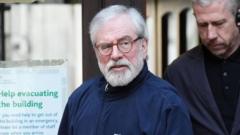
Adams, for his part, has always maintained his innocence regarding the bombing. His legal team argued that the case was "tortuous" and lacked a direct link. With the withdrawal, he remains legally untouched by the allegations of that day. He walks away with his record clear of this specific judgment, while the survivors walk away with the same questions they had in 1973.
The Ethics of the End
There is a hollow feeling in a victory won by exhaustion. The legal system is designed to provide "finality," but finality is not the same thing as "truth."
We often tell ourselves that the law is a grand quest for what really happened. In reality, the law is a set of rules about what we are allowed to say happened. When a case is withdrawn because the evidence is classified or the liability rules are too narrow, the truth doesn't change—it just becomes inadmissible. It stays in the shadows, unacknowledged but present.
Consider the survivors. They are older now. Their hair has grayed; their movements have slowed. They didn't want a payout that would change their lives; they wanted a public record that recognized their pain. They wanted to look at the history books and see a name attached to the fuse.
Instead, they are met with a "discontinuance." It is a cold word. It sounds like a canceled subscription or a broken circuit.
The Ghost in the Courtroom
The withdrawal of this case signals a broader, more uncomfortable reality about the "Troubles" and the long shadow they cast over the present. We are living in an era where the legal avenues for historical accountability are being systematically closed. Whether it’s through new legislation in the UK aimed at ending prosecutions related to the conflict or through the natural attrition of civil cases like this one, the door is slamming shut.
The 1973 Old Bailey bombing is moving from the realm of "news" into the realm of "history."
In history, we don't need a judge's permission to look at the evidence. We don't need a "balance of probabilities" to understand the mechanics of power and the cost of political violence. But for the people who were there—the ones who still hear a loud noise and feel their heart skip a beat—history isn't something in a book. It’s a physical sensation.
As the legal teams packed their bags and the courtroom lights were dimmed, the silence returned to the Old Bailey. It is a silence that Gerry Adams has navigated with masterful precision for half a century. It is a silence that the victims tried to break with the weight of their testimony.
The case is gone. The files remain locked. The Cortina sits forever at the curb in the minds of those who survived it, a ghost that the law was never quite brave enough to exorcise.
The victims didn't lose because they were wrong. They lost because time and the state have a way of protecting their own secrets, leaving the injured to carry the debris of the past alone.