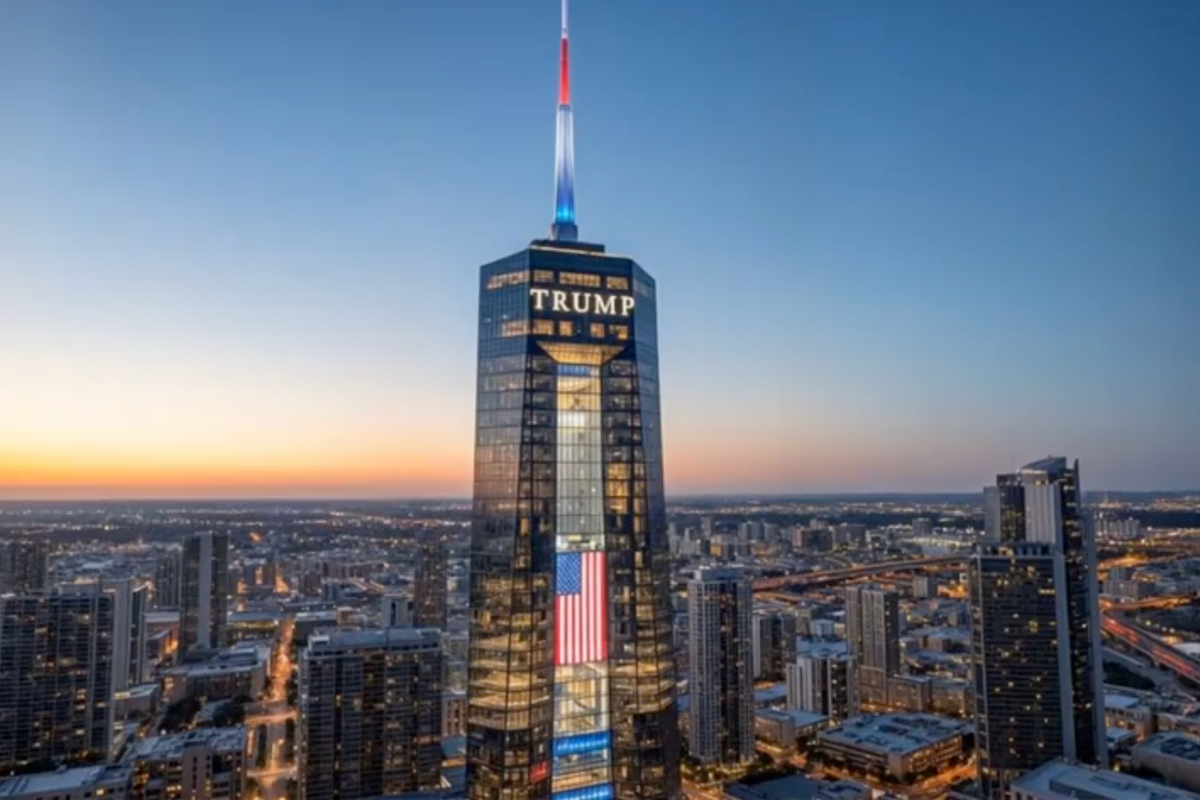
The convergence of the Presidential Libraries Act (PLA) and private real estate development has created a novel asset class that operates at the intersection of public record-keeping and private equity. While the public discourse surrounding Gavin Newsom’s critique of Donald Trump’s proposed library focuses on political rhetoric, the underlying reality is an exercise in regulatory arbitrage. By integrating a high-density hotel into the architectural and legal framework of a presidential library, a developer effectively transforms a tax-advantaged, non-profit commemorative site into a commercial engine. This strategy relies on three structural pillars: land-use flexibility, the monetization of historical prestige, and the exploitation of the "public-private" gray zone inherent in post-1955 presidential archives.
The Structural Mechanics of Mixed-Use Commemorative Assets
The Presidential Libraries Act of 1955 establishes that while the National Archives and Records Administration (NARA) operates the facility, the land and the building must be provided by a private, non-profit organization. This creates a permanent split in ownership and liability. The "grift" referenced in political headlines is, from a technical perspective, a capital stack optimization. Don't forget to check out our previous article on this related article.
When a library is designed to "double as a hotel," it solves the primary financial burden of all presidential libraries: the endowment requirement. Federal law requires a private foundation to provide an endowment equivalent to 60% of the total cost of the facility to cover NARA’s future operating expenses. By embedding a revenue-generating hospitality asset within the library footprint, the developer creates a recurring cash flow to service this endowment debt. This isn't merely a library; it is a self-amortizing monument.
The Three Pillars of Commercial Integration
- Zoning and Land-Use Lever: Presidential libraries often receive expedited environmental and zoning approvals due to their status as "civic" or "educational" institutions. Incorporating a hotel allows the developer to bypass the standard barriers to entry for luxury hospitality in high-value or protected areas.
- Brand Equity Capture: Unlike a standard Hilton or Marriott, a library-hotel captures the "sovereign premium." The ability to market a stay "within the archives" or in proximity to high-security federal artifacts allows for a RevPAR (Revenue Per Available Room) that exceeds the local market average by 25% to 40%.
- The Endowment Shield: Because the hospitality portion is physically and legally tethered to the library, it can be shielded under the tax-exempt status of the 501(c)(3) foundation, provided the income is categorized as "related" to the mission or managed through a complex UBIT (Unrelated Business Income Tax) structure.
The Cost Function of Political Prestige
The criticism leveled by Newsom targets the breach of the "sacred" nature of the presidency, but the economic friction lies in the dilution of public space. In a traditional presidential library, 100% of the square footage is dedicated to public education and archival storage. In the proposed Trump model, the ratio of public-to-private space shifts. This creates a "crowding out" effect where federal resources—including Secret Service details and NARA staff—provide implicit security and operational subsidies for the commercial wing of the building. To read more about the history here, Reuters offers an informative breakdown.
The cost function of this model is borne by the taxpayer in two ways:
- Infrastructure Subsidies: Municipalities often provide roads, utilities, and tax increments (TIF) to support the "civic" library, which the hotel then utilizes for free.
- Operational Risk: If the hotel fails as a business venture, the legal entanglements of a bankrupt entity physically attached to a federal archive create an unprecedented jurisdictional crisis.
The Conflict of Interest Framework
The integration of a hotel into a library creates a permanent loop of influence monetization. Under standard ethics frameworks, a library is a static repository of history. Under a hospitality-integrated model, it becomes a dynamic venue for lobbying. Foreign dignitaries, corporate interests, and political action committees (PACs) can funnel capital directly into the former president’s ecosystem via "room nights" and "event bookings" without the transparency required of campaign contributions.
This creates a bottleneck in ethical oversight. Federal law regulates the records within the building, but it has no jurisdiction over the occupants of the suite next door. The hotel serves as a regulatory "black box" where the financial interests of the former executive are shielded by the physical walls of a federal institution.
Distinguishing Fact from Political Hypothesis
To evaluate the validity of the "grift" claim, one must isolate the known variables from the speculative outcomes.
The Known Facts:
- The Trump Organization has historically utilized its real estate portfolio as its primary vehicle for political branding.
- Modern presidential libraries (including Obama’s and Clinton’s) have increasingly moved toward "community hub" models that include commercial components like cafes and gift shops.
- The 60% endowment rule is the single largest hurdle for any new presidential library, necessitating aggressive fundraising or creative revenue streams.
The Educated Hypotheses:
- The hotel component is likely a response to a shrinking donor pool. As traditional high-net-worth donors become wary of political polarization, the library must rely on a B2C (Business-to-Consumer) revenue model rather than pure philanthropy.
- The "hotel" designation may be a placeholder for a "private club" model, which offers even higher margins and lower public transparency than a standard hotel.
The Mechanism of Archive Degradation
A significant risk ignored by the political back-and-forth is the preservation-to-profit ratio. Archival storage requires precise environmental controls: a constant $60^{\circ}F$ ($15.5^{\circ}C$) and 40% relative humidity. Hospitality environments require human comfort levels, typically $72^{\circ}F$ ($22^{\circ}C$).
When these two systems are integrated into a single HVAC (Heating, Ventilation, and Air Conditioning) infrastructure to save on construction costs, the risk of mechanical failure increases. If the developer prioritizes the "hotel guest experience" over "archival integrity" during a budget shortfall, the physical history of the United States becomes a secondary priority to the commercial viability of the asset.
Strategic Recommendation: The Separation of State and Suite
The logical endpoint of this trend is the complete commodification of the presidency. If the Trump model succeeds, it will set a precedent for every future executive to view their post-presidency not as a period of service, but as a real estate exit strategy.
To mitigate this, the legislative framework must be updated to include a Commercial Proximity Clause. This would mandate a physical and financial "firewall" between NARA-operated spaces and any revenue-generating hospitality or residential units. Without this, the Presidential Libraries Act becomes a loophole for permanent, federally-subsidized branding.
The immediate strategic move for oversight bodies is to audit the Land Use Agreement of the proposed site. If the project utilizes any public land or municipal bonds, the commercial revenue should be legally tethered to the public archive's maintenance, with a "clawback" provision that triggers if the hotel's footprint exceeds a specific percentage of the total square footage. This ensures the library remains a civic asset rather than a commercial development wearing the mask of a monument.