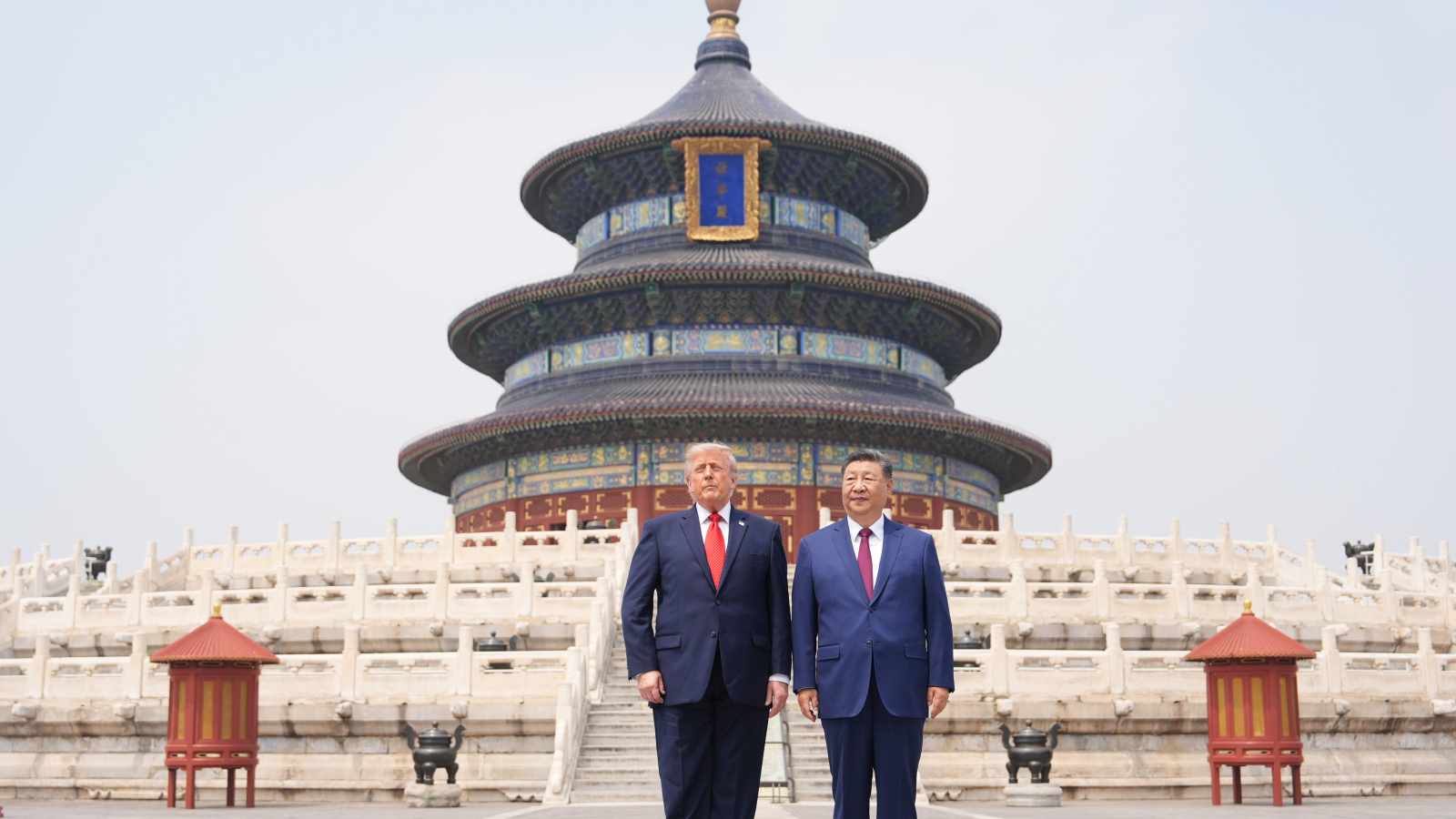
The Beijing summit between the United States and China functioned not as a resolution of conflict, but as a calibration of the structural guardrails required to prevent a descent into kinetic engagement. While superficial media narratives focus on diplomatic optics, the underlying mechanics of the discussion reveal a calculated effort to manage the decoupling of critical supply chains without triggering a global liquidity crisis or a total breakdown in communications. The meeting operated on a foundational principle of "strategic clarity within tactical ambiguity," where both parties identified the specific variables that constitute a casus belli while maintaining flexible positions on lower-stakes trade disputes.
The Tripartite Architecture of Bilateral Stability
The dialogue moved through three distinct layers of geopolitical interest, each governed by a different set of incentives and risks. Understanding the summit requires isolating these layers and examining how they interact to create the current state of "managed competition."
1. The Security Baseline and Deconfliction Protocols
The primary objective of the Beijing summit was the re-establishment of high-level military-to-military communication channels. The suspension of these protocols created an information vacuum, increasing the risk of accidental escalation in the South China Sea and the Taiwan Strait.
The restoration of these links serves as a "circuit breaker" in the bilateral relationship. In the absence of direct communication, each actor is forced to interpret the other’s tactical maneuvers through the lens of worst-case scenario planning. This feedback loop drives military spending and heightens the probability of a "Gray Zone" encounter—an incident that falls below the threshold of open war but requires a forceful response—spiraling out of control.
2. High-Tech Containment and Economic Asymmetry
The economic component of the summit was dominated by the "Small Yard, High Fence" strategy. The United States signaled that its restrictions on advanced semiconductors, quantum computing, and AI hardware are non-negotiable security imperatives rather than trade bargaining chips.
China’s response focused on "Industrial Overcapacity," a term that masks the fundamental structural shift in the Chinese economy. As the domestic real estate sector—formerly 25-30% of GDP—continues to contract, the Chinese state has redirected capital toward high-end manufacturing (EVs, lithium-ion batteries, and solar technology). This creates a global deflationary pressure that threatens the nascent industrial bases of the US and EU.
- The US Perspective: Targeted export controls are necessary to prevent the dual-use application of civilian technology for military modernization.
- The Chinese Perspective: These controls constitute "technological containment" designed to prevent China from escaping the middle-income trap and achieving high-value economic self-sufficiency.
3. Transnational Cooperation on Non-Kinetic Threats
To maintain the appearance of a functioning relationship, both leaders pivoted toward areas where interests align without compromising sovereignty. This includes the regulation of precursor chemicals for synthetic opioids and the establishment of a bilateral working group on Artificial Intelligence safety. These are "low-friction" sectors used to build a track record of cooperation that can be leveraged during higher-stakes negotiations.
The Cost Function of Decoupling
Strategic decoupling is often discussed as a binary choice, yet the Beijing summit highlighted that it is actually a spectrum of increasing costs. The discussions revealed that both nations are currently performing a cost-benefit analysis of "De-risking" vs. "Decoupling."
The price of total decoupling is currently estimated to be prohibitive for both economies. For the United States, it would mean a sharp increase in consumer inflation and a massive capital expenditure requirement to reshore manufacturing. For China, it would mean the loss of its most lucrative export markets and access to the USD-denominated financial system.
The summit served as a forum to define the "tolerable level of pain." Both sides agreed that certain dependencies—specifically in pharmaceuticals and critical minerals—are too dangerous to maintain, but a wholesale break in the consumer electronics or agricultural sectors would be mutually assured economic destruction.
Algorithmic Governance and the AI Safety Frontier
The inclusion of AI safety in the Beijing talks marks a shift in how sovereignty is defined in the 21st century. The concern is no longer just about who builds the fastest chip, but who defines the ethical and operational guardrails for autonomous systems.
There is a shared existential risk regarding the "alignment problem" in AI. If an autonomous system—whether in a financial market or a drone swarm—acts outside of its programmed parameters, the resulting chaos does not respect national borders. The Beijing dialogue established that while the two nations will compete fiercely to develop the most powerful Large Language Models (LLMs) and Artificial General Intelligence (AGI), they must share data on catastrophic failure modes to prevent a global systemic collapse.
The Taiwan Strait and the Red Line Equilibrium
The most significant point of friction remains the status of Taiwan. The summit did not produce a breakthrough, but it did re-verify the "Red Lines" that neither side is willing to cross.
The United States maintains its "One China" policy but continues to increase the "porcupine" defense capabilities of Taiwan. China maintains its goal of "reunification" but recognizes that a premature military intervention would likely lead to a total economic embargo and the potential destruction of the very semiconductor infrastructure (TSMC) it seeks to control.
This creates a state of "unstable equilibrium." The goal of the summit was not to solve the Taiwan issue—which is currently unsolvable—but to ensure that both sides accurately perceive the other’s thresholds. Miscalculation, rather than malice, is identified as the highest risk factor for conflict.
Tactical Bottlenecks in the Relationship
Despite the high-level agreements, several operational bottlenecks prevent a true "thaw" in relations:
- Investment Restrictions: Executive orders from the US Treasury continue to restrict private equity and venture capital from flowing into Chinese tech firms, starving the Chinese startup ecosystem of western expertise and liquidity.
- Data Sovereignty: China’s restrictive data laws make it nearly impossible for US firms to operate with transparency, while US concerns over TikTok and other platforms create a reciprocal barrier for Chinese firms.
- Domestic Political Constraints: Both leaders are constrained by internal hawkishness. In the US, any perceived "softness" on China is a political liability; in China, the CCP must project strength to maintain internal legitimacy amidst a slowing economy.
Re-Engineering the Supply Chain Architecture
The Beijing summit confirmed that the era of "Chimerica"—the deep, symbiotic integration of the US and Chinese economies—is over. What is replacing it is a bifurcated global trade system.
Investors and corporations must now navigate a world of "Double Standards." Products must be designed to meet two different sets of regulatory, data, and security requirements. This duplication of effort is an inherent "friction tax" on global growth, but it is the price of geopolitical stability.
The pivot toward "Friend-shoring" (moving supply chains to allied nations like Vietnam, India, or Mexico) is accelerating. However, the summit made it clear that even these new supply chains often rely on Chinese intermediate goods. The "decoupling" is often a rebranding of the supply chain rather than a fundamental severance.
The Strategic Path Forward
The Beijing summit should be viewed as the inaugural meeting of a permanent "Crisis Management Committee." The relationship has shifted from one based on mutual growth to one based on mutual survival.
The immediate strategic priority for global actors is to build "Geopolitical Redundancy." For corporations, this means diversifying supply chains so that a disruption in the Taiwan Strait does not result in a total operational halt. For governments, it means investing in "Sovereign Capabilities" in energy, food, and technology.
The next twelve months will be defined by how the agreed-upon communication channels handle small-scale provocations. If the military hotlines are used to de-escalate a collision in the South China Sea, the summit will be judged a success. If they remain silent during the next crisis, the Beijing summit will be remembered as a final, failed attempt at diplomacy before a systemic break.
The logic of the current era dictates that stability is not the absence of tension, but the presence of robust mechanisms to manage it. The Beijing summit installed those mechanisms; their durability is the only variable that matters.