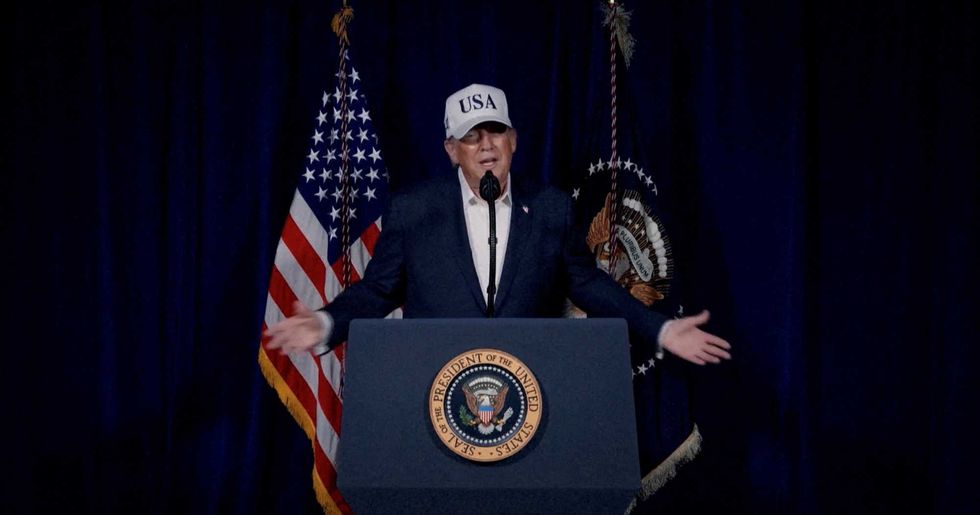
Pete Hegseth’s recent assertion that the United States did not initiate the current friction with Iran but possesses the absolute will to "finish it" marks a fundamental shift in American defense posture. This is more than a rhetorical flourish for a domestic audience. It represents a pivot toward a policy of unapologetic restoration of deterrence through the credible threat of overwhelming force. By framing the conflict as a reactive necessity rather than an elective engagement, the administration is signaling to Tehran that the era of managed escalation—where both sides trade low-level blows without crossing red lines—is effectively over.
The geopolitical math is changing. For decades, the U.S.-Iran relationship functioned like a grisly chess match played through proxies in Lebanon, Iraq, and Yemen. Washington’s strategy focused on containment and economic strangulation via sanctions. Hegseth’s stance suggests a move away from that "gray zone" warfare toward a more binary outcome. If the "finish it" directive is taken literally, it implies a readiness to target the structural foundations of the Iranian regime's power, including its nuclear infrastructure and internal security apparatus, should provocations continue.
The Calculus of Proactive Deterrence
Modern military strategy often relies on the concept of "strategic ambiguity," keeping an adversary guessing about the exact threshold for war. Hegseth has discarded that ambiguity. The logic here is that Iran’s "Axis of Resistance" has only expanded because they perceived American restraint as weakness. By stating that the U.S. will finish the job, the Pentagon is attempting to re-establish a "red line" that actually carries weight.
History provides a brutal lesson in this department. In 1988, during the "Tanker War," the U.S. launched Operation Praying Mantis after an American frigate hit an Iranian mine. In a single day, the U.S. Navy destroyed a significant portion of Iran's functional fleet. That action forced Ayatollah Khomeini to "drink the poison" and accept a ceasefire in the Iran-Iraq War. The current administration appears to be looking at that 1988 playbook as a model for how to handle modern escalations. They aren't looking for a twenty-year occupation; they are looking for a decisive, crippling blow that removes the opponent's ability to fight.
Regional Proxies and the Risk of Total War
While the rhetoric focuses on a direct U.S.-Iran confrontation, the reality on the ground is far more cluttered. Iran’s primary defense mechanism is its network of non-state actors. Hezbollah in Lebanon, the Houthis in Yemen, and various militias in Iraq serve as a "forward defense" for Tehran.
If the U.S. moves to "finish" a conflict with Iran, these groups will likely be activated simultaneously. This creates a multi-front nightmare that could overwhelm regional air defenses.
- Hezbollah possesses an arsenal of over 150,000 rockets, many of which are precision-guided.
- The Houthis have proven capable of disrupting global shipping in the Red Sea, a choke point for 12% of world trade.
- Iraqi Militias sit within striking distance of U.S. diplomatic and military personnel.
The "finish it" strategy must account for these variables. A strike on Iranian soil is never just a strike on Iranian soil. It is a spark in a room filled with gasoline. Analysts argue that for Hegseth's vision to succeed, the U.S. would need to neutralize these proxy capabilities concurrently with any direct action against the Islamic Revolutionary Guard Corps (IRGC). This requires a level of military coordination and resource allocation that the U.S. hasn't seen since the 2003 invasion of Iraq, yet the current objective is the opposite of nation-building.
The Economic Ghost in the Machine
You cannot discuss a "final" conflict with Iran without addressing the global oil supply. Iran sits on the Strait of Hormuz, a narrow waterway through which roughly one-fifth of the world’s total oil consumption passes daily.
If the conflict escalates to the point Hegseth describes, Tehran’s most effective weapon isn't a missile; it's a blockade. Sinking a few tankers or mining the strait would send global oil prices into a vertical climb. Even a temporary closure could trigger a global recession, putting the administration in a difficult position where military success might lead to economic catastrophe at home.
The administration's gamble is that the threat of total destruction will keep Iran from pulling the oil trigger. It is a high-stakes game of chicken where the "finish it" rhetoric acts as the primary tool of intimidation. If the bluff is called, the U.S. must be prepared to not only win the kinetic battle but also to clear the strait and stabilize global markets in record time.
Intelligence Gaps and the Nuclear Factor
The most pressing "why" behind this hardening stance is the Iranian nuclear program. International monitors have warned for months that Iran’s breakout time—the time needed to produce enough weapons-grade uranium for a nuclear device—has shrunk to a matter of days or weeks.
The U.S. intelligence community is haunted by the failures of the past, specifically the inability to accurately predict nuclear milestones in North Korea. There is a growing consensus in the Pentagon that a "contained" Iran is no longer possible if they possess a nuclear deterrent. This changes the "finish it" directive from a threat of retaliation into a race against the clock.
If Hegseth and the Trump administration believe that diplomacy is a dead end, then the military option becomes the only remaining lever. This involves more than just bombing facilities. It requires a sustained campaign to degrade Iran’s scientific and logistical networks.
Domestic Support and the Shadow of "Forever Wars"
Hegseth’s background as a veteran and a media personality gives him a unique platform to sell this strategy to a war-weary American public. However, there is a massive difference between a surgical strike and "finishing" a conflict with a nation of 88 million people.
The American electorate has little appetite for another protracted Middle Eastern entanglement. To maintain domestic support, the administration must frame any action as a "fast and decisive" operation. They are banking on the idea that the public will support a massive, short-term show of force if it prevents a decades-long commitment.
But war is rarely tidy. Once the first missile is fired, the enemy gets a vote in how the conflict ends. Iran’s strategy has always been to bleed its opponents through "strategic patience." They don't need to win a naval battle against the U.S. Fifth Fleet; they just need to survive longer than the American news cycle.
Reconstructing the Deterrence Ladder
To understand how the U.S. intends to "finish" this, one must look at the deterrence ladder. In previous years, the U.S. stayed on the bottom rungs: sanctions, diplomatic isolation, and occasional cyberattacks like Stuxnet.
Hegseth is signaling a jump to the top rungs. This involves:
- Targeting high-value IRGC leadership.
- Destroying drone and missile production facilities.
- Directly hitting command and control centers in Tehran.
By skipping the middle rungs of gradual escalation, the administration hopes to shock the Iranian leadership into submission. It is a philosophy of "maximum pressure" transitioned from the economic realm to the kinetic realm. The risk is that if the shock doesn't work, there is nowhere left to go but total war.
The "finish it" doctrine assumes that the Iranian regime is a rational actor that values its survival above its ideological goals. If that assumption is correct, Hegseth’s bluntness might actually prevent a war by making the cost of defiance too high to bear. If the assumption is wrong, the U.S. is currently telegraphing the opening moves of the largest military engagement of the 21st century.
Verify the readiness of regional assets and the resilience of the global energy supply chain. The rhetoric has already crossed the Rubicon; the logistics must now follow, or the threat becomes a liability.