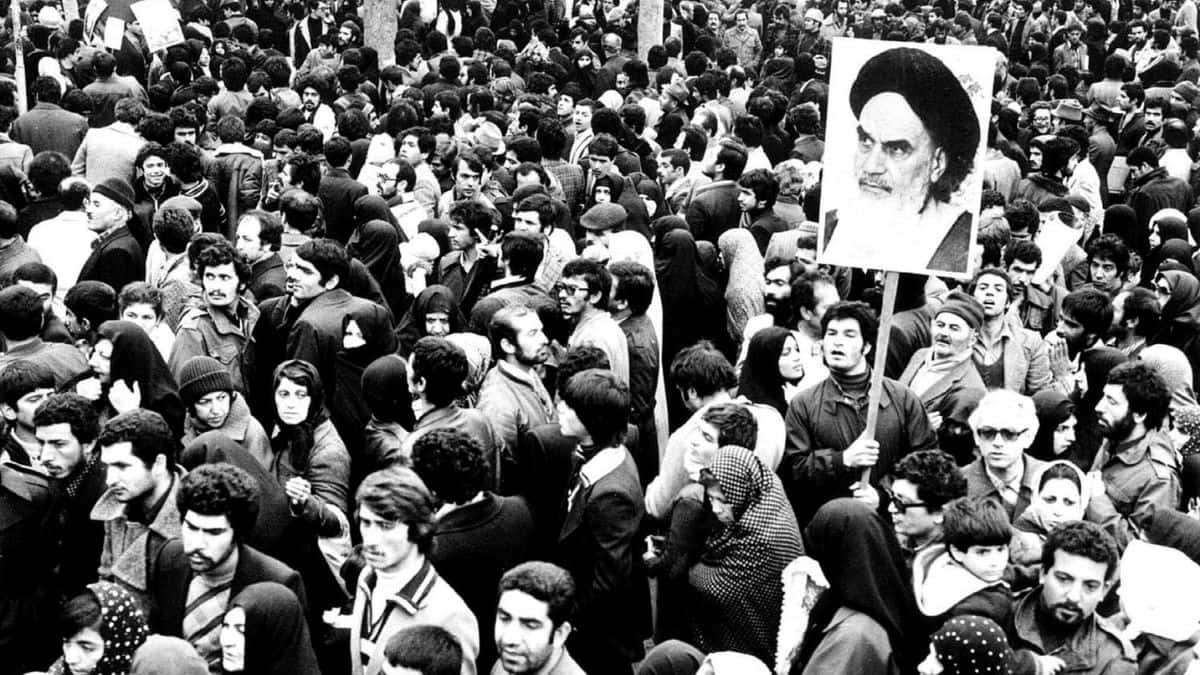
The air in Tehran during the autumn of 1978 didn't just smell of exhaust and roasting beets; it smelled of electricity. You could feel it on the back of your neck. It was the feeling of a million people holding their breath at once, waiting for a single, shattering exhale.
Picture a young law student named Omid. He is sitting in a cramped cafe, clutching a forbidden cassette tape as if it were a holy relic. On that tape is the scratchy, distant voice of an elderly cleric exiled in France. To Omid, that voice isn't just about religion. It’s about dignity. It’s about the end of a secret police force that could make your cousin disappear for owning the wrong book. He dreams of a "Republic," a word that tastes like cool water in a desert.
Omid didn't know that he was helping to build a cage. He thought he was building a cathedral.
The 1979 Iranian Revolution wasn't a sudden trapdoor. It was a slow, deliberate construction project. The blueprint was a concept so alien to modern governance that most Western observers didn't even have the vocabulary to describe it: Velayat-e Faqih, or the Guardianship of the Jurist. To understand how a modern state handed its soul over to a single office, you have to look past the protests and into the desperate, brilliant mind of Ruhollah Khomeini.
The Architect in the Garden
While the Shah was busy buying fighter jets and throwing gold-plated parties in the ruins of Persepolis, Khomeini was sitting on a rug in a quiet village outside Paris. He wasn't talking about tax brackets or infrastructure. He was talking about the cosmic imbalance of the world.
He argued a simple, devastating point. If God is the ultimate legislator, then the person who understands God’s law best should be the one running the shop. It sounds logical in a vacuum. But in practice, it meant shifting the very foundation of power from the "will of the people" to the "interpretation of the divine."
Imagine a house where the residents vote on what color to paint the walls, what to eat for dinner, and how to spend the family budget. Now, imagine there is a silent grandfather sitting in the corner armchair. He doesn't cook. He doesn't clean. But he has a "veto." If he decides that blue paint is offensive to the ancestors, the walls stay white. If he decides the budget is being spent on "frivolities," the money stays in the bank.
That grandfather is the Supreme Leader. He isn't just a president; he is the shadow that the president walks in.
The Bait and the Switch
In the early days of 1979, the revolution was a messy, beautiful, terrifying mosaic. There were Marxists, liberals, secular students, and devout shopkeepers. They were all united by what they hated, which is always easier than being united by what they want.
When the Shah fled and the Boeing 747 carrying Khomeini touched down at Mehrabad Airport, the "Republic" part of the "Islamic Republic" was the selling point. People like Omid believed the clergy would act as moral guides—spiritual referees who would stay in the holy city of Qom and make sure the politicians didn't get too corrupt.
Then came the drafting of the constitution. This is where the story shifts from a street fight to a legal heist.
Khomeini's allies were masters of the long game. They didn't abolish the parliament. They didn't get rid of the presidency. Instead, they wrapped these democratic institutions in a layer of clerical cellophane. They created the Guardian Council—six theologians and six jurists. This group was given the power to disqualify any candidate for office who didn't fit their specific, rigid vision of Islamic loyalty.
Think about that for a second. You can vote, but you can only vote for the people the "grandfather in the chair" has pre-approved. It is a democracy with the engine removed.
The Ghost in the Machine
The genius—or the tragedy—of the system is its permanence.
The Supreme Leader, or Rahbar, isn't elected by the people. He is chosen by the Assembly of Experts, a group of clerics who are, themselves, vetted by the Guardian Council. It is a closed loop. A circle drawn in the sand that no outsider can cross.
By the time the constitution was finalized in December 1979, the stakes had changed. The takeover of the U.S. Embassy and the ensuing hostage crisis had turned the country into a fortress. In an atmosphere of "us versus the world," dissent wasn't just a political difference; it was treason against God.
Omid, our law student, saw his professors replaced. He saw the newspapers he loved shuttered one by one. The "Republic" he had marched for was still there on paper, but the "Guardianship" had swallowed it whole.
The Supreme Leader became the commander-in-chief of the armed forces. He became the head of the judiciary. He gained the power to dismiss the president. He became the personification of the state. If the President is the face of Iran, the Supreme Leader is the skull beneath the skin.
The Invisible Weight
We often talk about the Iranian government as a monolith, but that misses the human tension that keeps the gears turning. There is a profound exhaustion in living within a system where the rules can change based on a single man’s dream or a "divine" intuition.
Consider the "Dual Power" dynamic. Every four years, Iranians go to the polls to elect a president. They hope for change. They hope for a loosening of the social grip, for better ties with the world, for a life that feels a little less like a crusade. But every president, whether a hardliner or a reformer, eventually hits the same brick wall.
They realize they are not the captain of the ship. They are the person allowed to steer only as long as they stay on the course set by the man in the lighthouse.
The Supreme Leader system didn't just happen because of a religious fervor. It happened because of a calculated gamble that people would trade their agency for a sense of absolute certainty. It was the promise that there was someone who knew the "Truth" with a capital T, and that this Truth would protect them from the chaos of the West and the cruelty of the Shah.
The Cost of Certainty
Today, the streets of Tehran look very different than they did in 1979. The children and grandchildren of the revolution—the "Omids" of the 21st century—are no longer listening to cassette tapes. They are on VPNs, scrolling through a world that feels light-years away from the rigid structure of the Velayat-e Faqih.
They live in the friction between a 7th-century legal philosophy and a 21st-century reality.
The system created a country that is incredibly stable and incredibly brittle at the same time. Because the Supreme Leader is framed as the representative of the Hidden Imam, any failure of the state becomes a failure of the faith. If the economy tanks, if the water runs dry, if the morality police spark a nationwide protest, it isn't just a policy error. It’s a crack in the divine foundation.
The 1979 revolution didn't just change who sat in the palace. It changed the nature of truth in Iran. It turned the law into something that doesn't belong to the citizens, but to a ghost that haunts the halls of power, untouchable and unyielding.
Deep in the night, in the quiet suburbs of North Tehran, you can still find the remnants of that original dream. People still talk about the "Republic" they thought they were getting. They talk about it in whispers, behind closed doors, while the "grandfather" in the chair continues to watch, making sure the walls never change color.
The tragedy of the system isn't that it failed. The tragedy is that it worked exactly as it was designed to, leaving a nation to wonder when the exhale they started in 1979 will finally be allowed to finish.
A young woman adjusts her headscarf in a rearview mirror, catching a glimpse of a billboard featuring a bearded man who has ruled since before she was born, and for a fleeting second, she wonders who is actually holding the keys to her life.
Would you like me to analyze the specific legal articles of the 1979 Iranian Constitution that solidified this power?